 Citerank
AI Citation Leaderboard: who wins AI Overviews for a topic
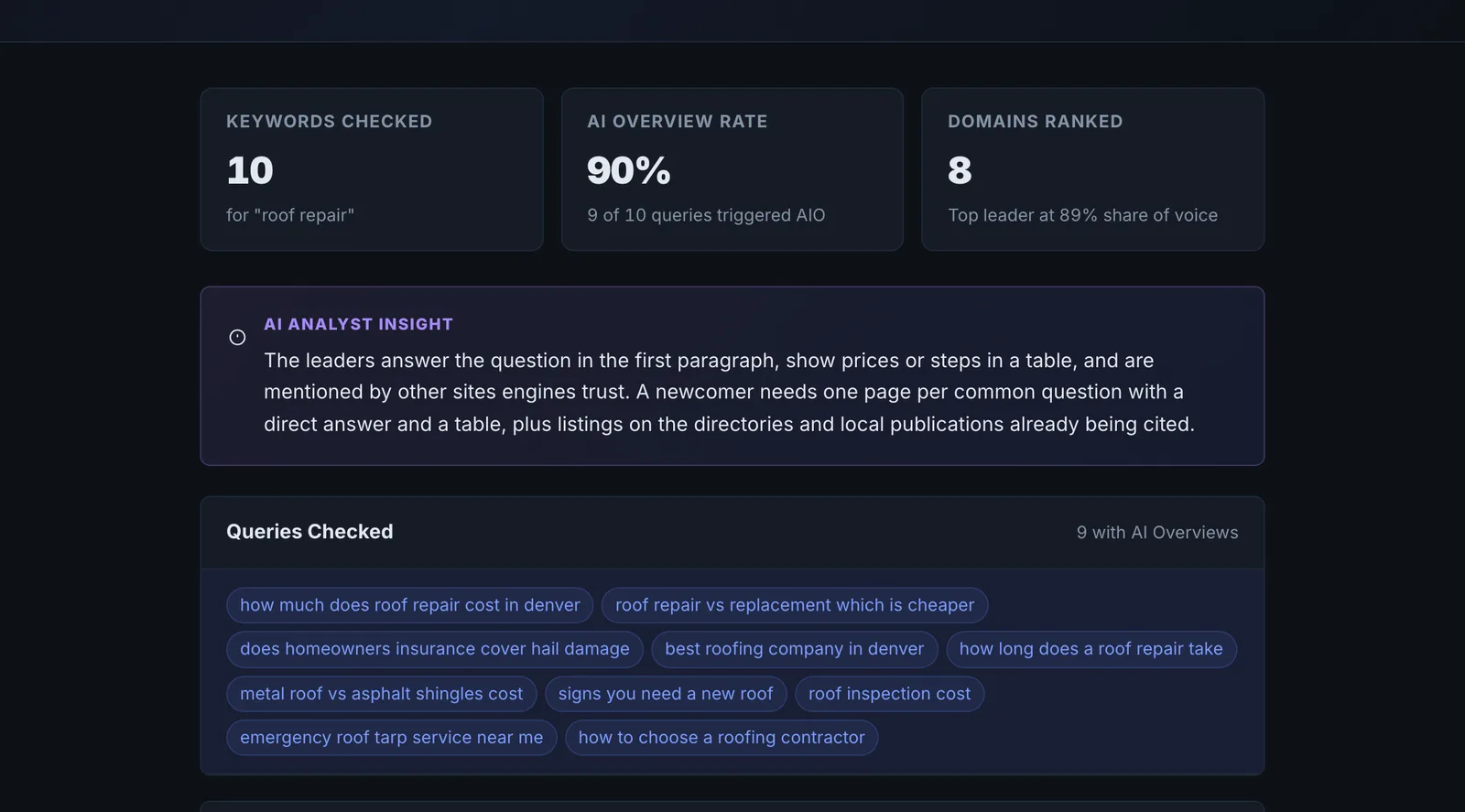
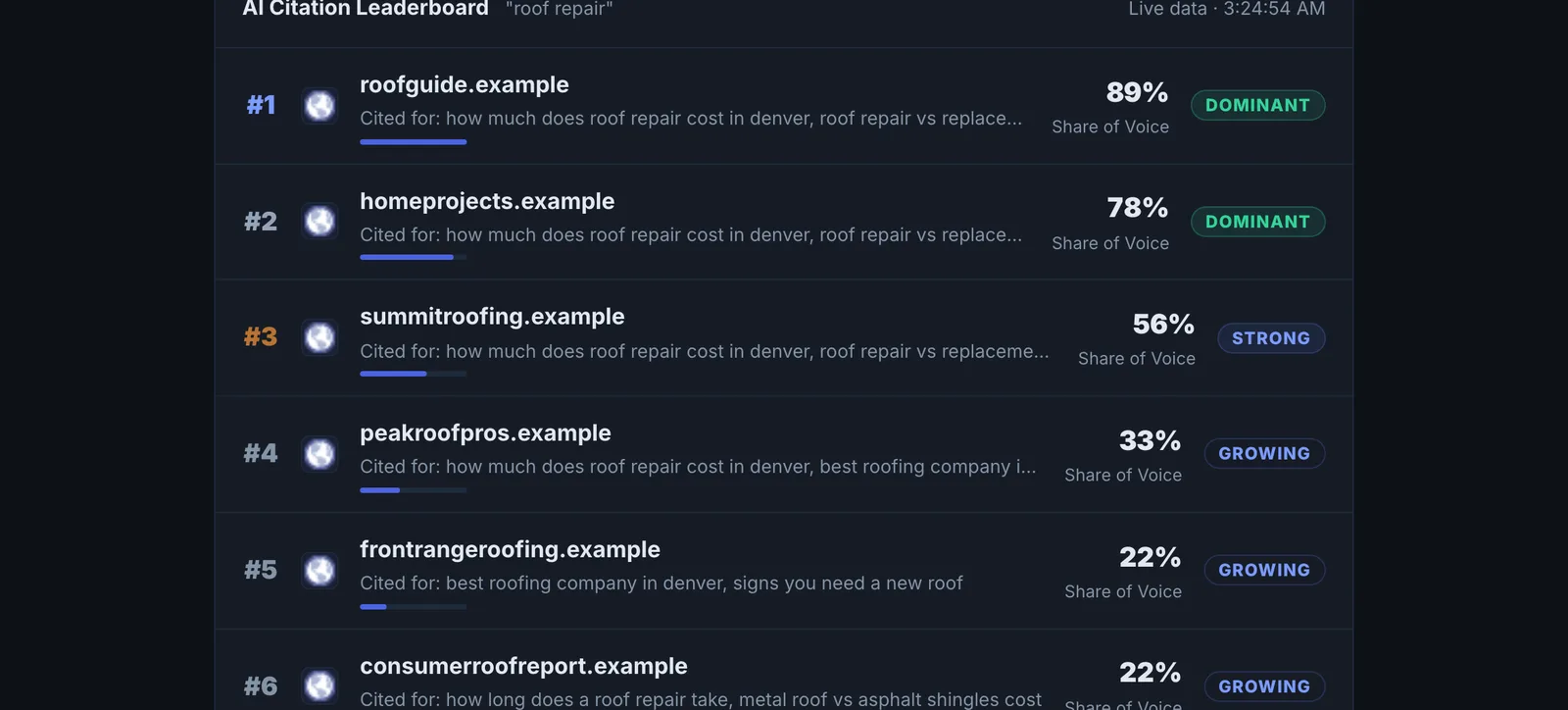
AI Citation Leaderboard expands a topic into keywords, checks Google AI Overviews for each, and ranks the domains cited most often by frequency and share of voice, with an AI summary of what the leaders have in common.
Step by step
- Open AI Citation Leaderboard #
Find it under Competitors in the left sidebar.
- Enter a topic #
Any keyword or topic.
- Run it #
The topic is expanded into keywords and each checked for an AI Overview.
- Read the ranking #
See the domains ranked by citations and share of voice.
- Study the leaders #
Open the top domains' cited pages and note what they share.
Why it matters#
A quick answer to "who does Google's AI trust on this topic?" It is useful for scoping a market, finding partners and publications to target, and showing a client who they are really up against.
What it checks#
- The topic expanded into up to 10 keywords.
- Each keyword searched live for an AI Overview and its cited domains.
- Domains ranked by citation count and share of voice.
- An AI synthesis of the pattern.
Reading the results#
- Share of voice is the share of all AI Overview citations that go to each domain.
- Publishers and directories at the top mean you need to be mentioned there, not just outrank them.
- Competitors at the top are your benchmark pages.
Implementing the fixes#
- For publisher leaders, pitch inclusion or contribute content (Off-Site Mention Gap).
- For competitor leaders, compare their cited pages with yours (Citation Gap).
Worked example#
A cybersecurity consultancy runs "SOC 2 compliance".
The topic expands into 10 keywords. The leaderboard: a compliance software vendor with 31% share of voice, an audit firm with 18%, a government page with 9%. The consultancy is not in the top 10. Seven of the top 10 domains are vendors and audit firms that publish detailed guides; none are directories.
What the team does: studies the vendor's top-cited page (a checklist with a timeline and costs), writes a more specific guide for companies under 50 people, a group the vendor's page does not address, and runs the leaderboard again a month after publishing.
Best practice#
Use it for discovery; for tracking over time use Category Intelligence or Citation Tracker.
Troubleshooting
Keywords could not be generated #
The app saysCould not generate keywords for this topic
The topic is too short or too vague. Use two to five words that describe a market, such as "SOC 2 compliance" rather than "SOC".
The leaderboard is busy #
The app saysThe leaderboard is busy right now. Please try again in a minute.
Many leaderboards are being built at once. Try again in a minute.
Too many requests #
The app saysToo many leaderboard requests, please slow down.
Wait a few minutes between runs. Without an account, public use is limited to 20 topics an hour.
Not listed here? See Common problems for limits, checks, plans and pages that cannot be read.
Questions
Which engine does it rank? #
Are results cached? #
Does it use checks? #
Something here does not match what you see in the app? Tell us and we will fix the guide.