 Citerank
AI Overview Tracker: is a page ready for Google AI Overviews?
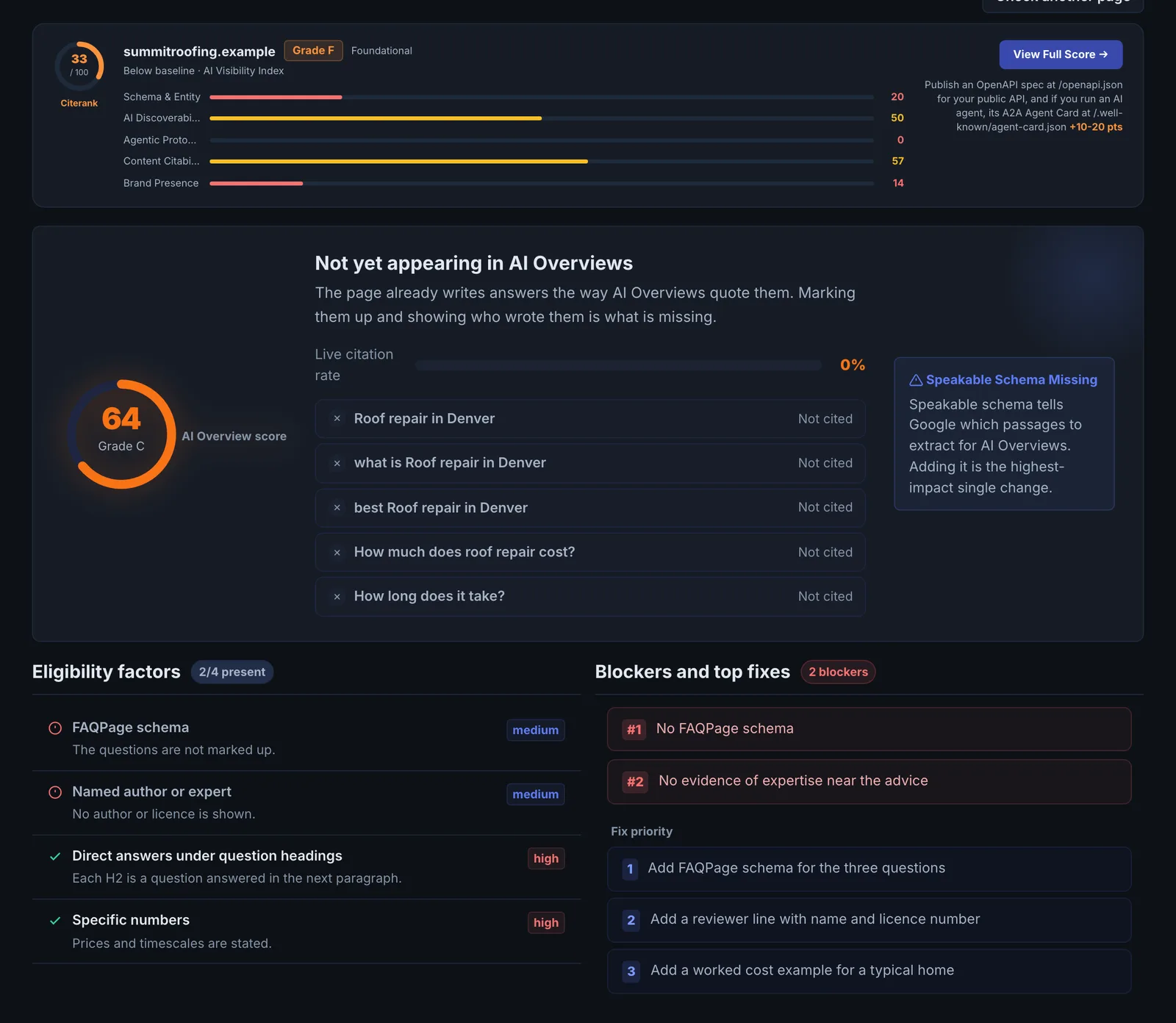
AI Overview Tracker reads a page, works out the questions it answers from its headings and FAQs, and asks Gemini with Google Search each one to see whether the page is cited. It scores the page's readiness for AI Overviews and gives fixes, including Speakable schema to copy.
Step by step
- Open AI Overview Tracker #
Find it under AI Visibility, Track, in the left sidebar.
- Enter a page URL #
Paste the full URL of a page that answers a question, such as a guide, service or FAQ page.
- Check the page #
Citerank reads the title, headings, FAQ schema and definitions, builds the questions the page answers, and tests them.
- Read the citation rate and gaps #
See which questions cite the page, which cite others, and the readiness signals that are missing.
- Copy the schema #
Use Copy Schema for the Speakable markup it generates, then apply the other fixes.
Why it matters#
Google AI Overviews quote passages from pages that answer the question cleanly. This tool looks at one page through that lens: does it answer identifiable questions, does the answer appear in a form that can be lifted, and does Google's own model cite it when asked? It is the fastest way to find out why a strong page is not appearing in AI Overviews and what to change on it.
What it checks#
- The page's structure: title, H1, H2s, clean body text, definition sentences ("X is ...") and FAQ pairs from FAQ schema.
- Speakable schema: whether the page marks the passages best suited to be read aloud or quoted.
- Citation tests: questions built from the page's own headings and FAQs, each asked of Gemini with Google Search. For each, it records whether your domain is cited and which domains are cited instead.
- A synthesis: an AI review of the results with specific fixes.
Reading the results#
- Citation rate is the share of the page's own questions where Gemini cites your page. Below half means the page is not seen as the best answer to its own topics.
- Cited instead shows who wins those questions. Open those pages and compare.
- Missing signals (no definition sentence, no FAQ, no Speakable, vague headings) are the structural reasons.
Implementing the fixes#
- Make headings questions where the section answers one ("How long does a roof repair take?").
- Answer in the first sentence under each heading, in 40 to 60 words, then expand.
- Add a definition sentence for the main term near the top ("A heat pump is ...").
- Add FAQ schema only for questions that are visibly answered on the page.
- Add the Speakable schema from Copy Schema, pointing at your best answer passages.
- Re-check after the page is recrawled.
Worked example#
A university tests its "What is a master's in data science?" page.
The tool builds 8 questions from the page's headings and FAQ. Gemini with Google Search cites the page on 2. Missing signals: no definition sentence (the page opens with "Join a world-class community..."), FAQ answers hidden in an accordion that is not in the HTML, and no FAQ schema.
The fixes: the first sentence becomes "A master's in data science is a one- to two-year graduate degree in statistics, programming and machine learning...", FAQ answers are put in the HTML with FAQPage schema. Re-run: cited on 5 of 8 questions. The two still lost go to a government careers page, which suggests adding salary and job-outlook figures with a source.
Best practice#
- Run it on your top informational pages first: guides, comparisons and FAQs are what AI Overviews quote most.
- Confirm whether Google actually shows an AI Overview for your main keyword with the SERP Features Tracker. Readiness only pays off where an Overview appears.
Troubleshooting
The page could not be fetched #
The app saysCould not fetch page. Ensure the URL is publicly accessible.
The page is behind a login, blocked by a firewall, or the address is wrong. Open it in a private window, and allow CiterankBot if a firewall is involved.
No test questions could be built #
The app saysCould not derive test queries from page content
The page has too little text, headings or FAQ for questions to be built from it, often because the content is loaded by JavaScript. Put the main text, headings and FAQs in the HTML the server sends.
The citation rate changes between runs #
Gemini's answers vary. Compare runs a few weeks apart, after changes, rather than one run against the next.
Not listed here? See Common problems for limits, checks, plans and pages that cannot be read.
Questions
Is this a live Google AI Overview check? #
Where do the test questions come from? #
Does it use checks? #
Something here does not match what you see in the app? Tell us and we will fix the guide.