 Citerank
Brand Intelligence: what AI believes about your brand and why
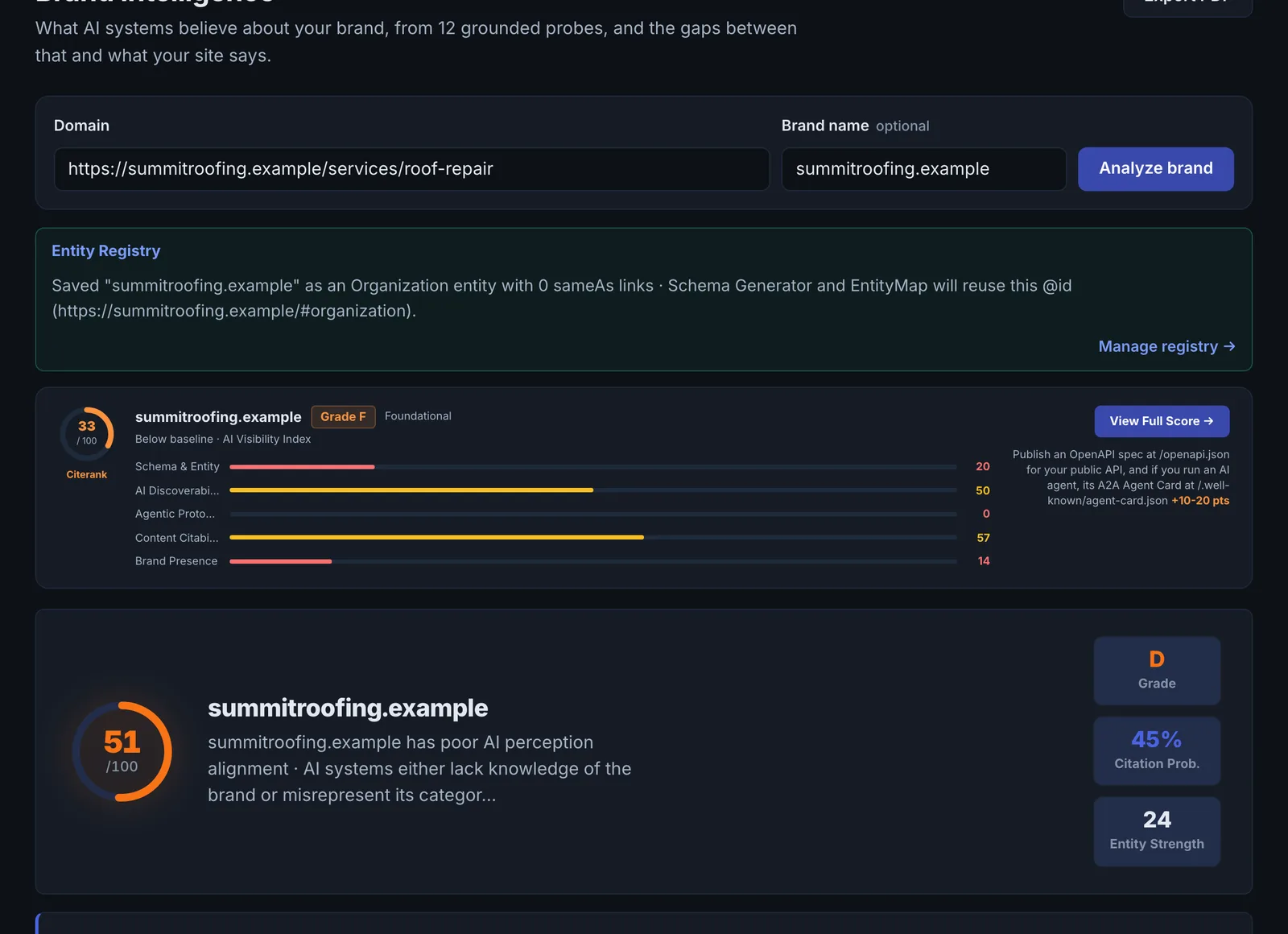
Brand Intelligence runs 12 grounded Gemini probes about your brand, audits every source the answers were built from, compares what AI believes with what your site claims, checks the Google Knowledge Graph, and generates the schema fixes to close the gaps.
Step by step
- Open Brand Intelligence #
Find it under AI Visibility, Brand, in the left sidebar.
- Enter your domain #
Optionally add the brand name, if it differs from what the site says.
- Run the analysis #
It reads your site's brand signals, runs 12 probes, checks the Knowledge Graph and builds the report.
- Compare AI Believes with Brand Claims #
Find each place where what AI says differs from what you say.
- Apply the schema fixes #
Copy the generated schema fixes and add them to your site.
Why it matters#
When AI gets your brand wrong, it is repeating something it read. Brand Intelligence finds what it believes, where it learned it, and which technical signals (schema, sameAs links, Knowledge Graph) would correct it. It turns "ChatGPT describes us badly" into a list of sources to fix and markup to add.
What it checks#
- Your brand signals: the Organization or business schema, name and sameAs links on your site.
- 12 grounded probes: Gemini with Google Search, asked about your brand from different angles, with sentiment and hedging detected in each answer.
- Citation source audit: every URL cited across the probes, grouped and classified by risk.
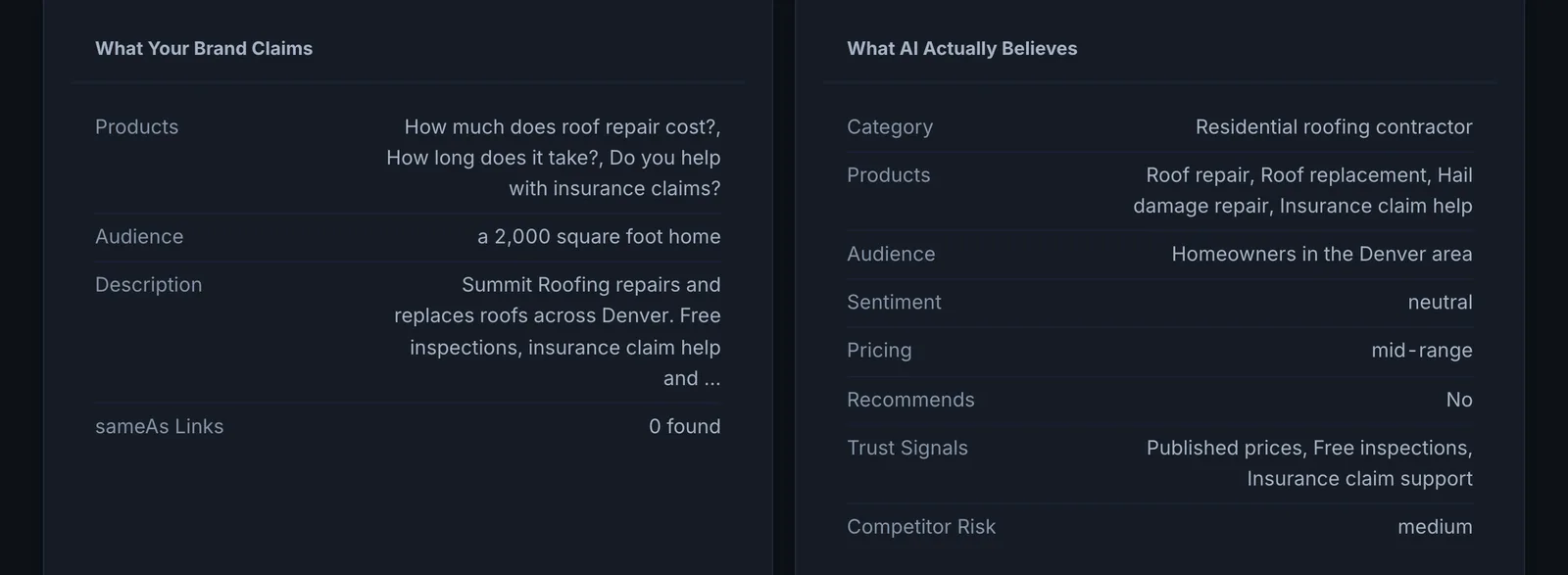
- Perception gaps: what AI believes compared with what your brand claims.
- sameAs strength: how well your schema links your brand to its official profiles.
- Knowledge Graph presence: whether Google has a confirmed entity for you, and its Wikidata link.
- Schema fixes and top recommendations.
Reading the results#
- AI Believes vs Brand Claims: each mismatch is a specific correction to make.
- Source audit: high-risk sources (outdated, competitor-owned or low quality) shaping what AI says are the priority.
- Knowledge Graph: not found, or found with low confidence, means Google does not yet have a firm entity for you.
- Hedging: many hedged answers mean little consistent information exists about you.
Implementing the fixes#
- Add the generated schema fixes, especially Organization with a stable @id and complete sameAs links (LinkedIn, Crunchbase, Wikidata, Google Business Profile, official social accounts).
- Correct the high-risk sources: update your listings, ask publishers to correct facts, and publish the correct facts clearly on your own About page.
- Build Knowledge Graph presence: consistent name, address and description everywhere; a Wikidata item if you meet its notability rules; claimed profiles on major platforms.
- Re-run after a few weeks to see the gaps close.
Worked example#
A boutique hotel group runs Brand Intelligence.
- AI Believes vs Brand Claims: Gemini says the group has 3 hotels. The site says 5. The two newest are missing.
- Source audit: the answers lean on a 2021 travel article and an old directory listing.
- sameAs strength: weak. The Organization schema links only to Instagram.
- Knowledge Graph: found, with low confidence.
The fixes: an "Our hotels" page listing all five with addresses, Organization schema with sameAs links to every official profile and each hotel's business profile, an update to the directory listing, and a press release on the two openings. Two months later, the probes name five hotels, and the outdated sources have dropped out of the audit.
Best practice#
Use Perception Score for how AI talks about you and Brand Intelligence for why. Run both before and after a brand clean-up.
Troubleshooting
The Knowledge Graph match is a different company #
The app saysLow name similarity, may be a different entity with a similar name
The closest entity has a similar name but may not be you. Make your name, URL and location unmistakable in your Organization schema and profiles, and add a Wikidata item if you qualify.
The Knowledge Graph lookup is rate limited #
The app saysRate limited, retry in 60s
Wait a minute and run again.
Many answers are hedged #
"May", "reportedly" and "it appears" mean there is little consistent information about the brand. That is the finding: publish clear facts on your site and get them repeated on trusted third-party profiles.
Not listed here? See Common problems for limits, checks, plans and pages that cannot be read.
Questions
What is the Knowledge Graph check? #
What does the source audit show? #
Does it use checks? #
Something here does not match what you see in the app? Tell us and we will fix the guide.