 Citerank
Off-Site Mention Gap: where AI reads about competitors, not you
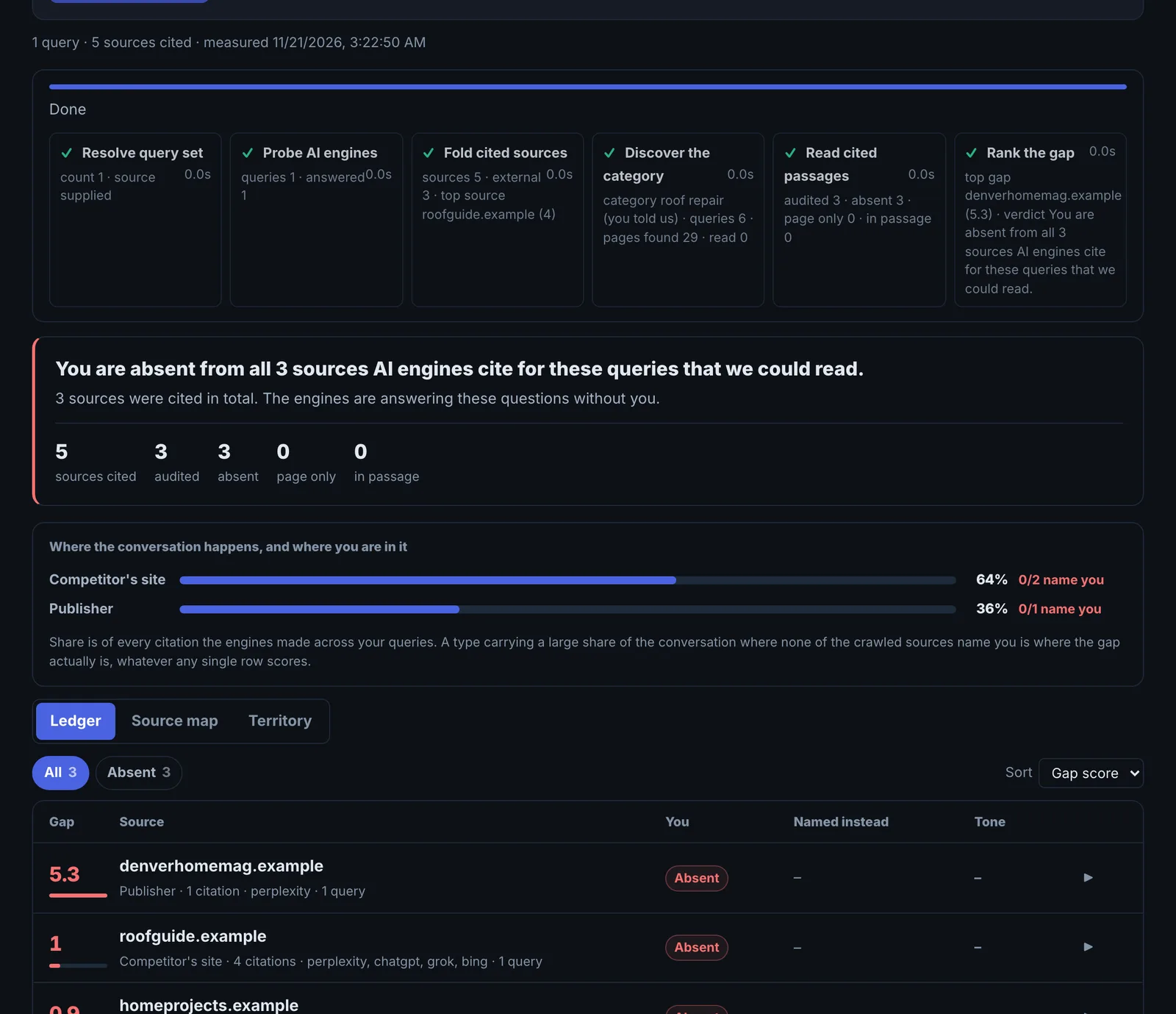
Off-Site Mention Gap runs your queries on the AI engines, collects every source they cite, then reads the most-cited pages to see whether they mention you, your competitors or neither. The result is a list of real pages to get included on.
Step by step
- Open Off-Site Mention Gap #
Find it under Competitors in the left sidebar.
- Enter your domain and competitors #
Add your domain, optionally your brand name and category, and your competitors, comma separated.
- Add queries #
Optionally list the queries to test, comma separated. Otherwise they are worked out for you.
- Run it #
Sources stream in as the engines answer and the top pages are read.
- Work the gaps #
Go through the pages that name a competitor and not you, starting with the sources most queries use.
Why it matters#
For many questions, AI engines do not cite the companies themselves. They cite list articles, reviews, directories and forums, and recommend whoever those pages name. If the pages engines rely on name your competitors and not you, no amount of on-site work changes the answer. This tool finds those exact pages.
What it checks#
- Your queries asked on the AI engines (ChatGPT, Perplexity, Grok, Bing and Google AI Overviews by default).
- Every cited source folded into one row per domain, ranked by how many queries used it.
- The most-cited page on each top source fetched and read, to see whether the passage the engine drew on names you, a competitor or nobody.
Reading the results#
- Names competitors, not you: your priority targets.
- Names nobody: a source the engines trust for the topic, open for anyone.
- Names you: protect it and keep the information current.
- The map / treemap: the weight of each source across queries; unaudited tail sources are shown but not read.
Implementing the fixes#
| Source type | How to get included |
|---|---|
| List or "best of" articles | Contact the author or publisher with a short, specific pitch and proof; offer data or a quote. |
| Review sites and directories | Create and complete your profile, and ask customers for reviews there. |
| Forums and communities | Take part genuinely where your expertise answers the question. |
| Industry publications | Contribute expert content or data. |
Re-run after a few weeks to see the gap close.
Worked example#
A project management tool runs its 10 tracked prompts.
Engines cite 140 sources, folded into 60 domains. Top sources: a software review site (used by 8 of 10 prompts), a large Q&A forum (6) and a tech blog's "best tools" list (5). The audited pages show: the review site names three competitors and not the tool; the forum thread names nobody useful; the blog list names the tool, but with a two-year-old description.
The work: get reviews on the review site (the tool had 4 there; competitors had hundreds), answer the forum question with a helpful post that discloses the affiliation, and ask the blog to update the description. Six weeks later, the review site's page names the tool, and two prompts in Prompt Tracking now cite that page with the tool in the answer.
Best practice#
Use the same queries as your Prompt Tracking list, so off-site work targets the prompts you measure.
Troubleshooting
No external sources were cited #
The app saysno external sources were cited
The engines answered without sources, or cited only you. Try prompts with comparison or "best" intent, which draw on third-party sources.
The competitor columns are empty #
The app saysno competitors given
Add competitor domains, so each source shows whether it names them.
Some sources are shown but not read #
The top sources are fetched and read. Tail sources (used by one or two prompts) are shown for weight but not read, to keep runs fast and costs fair. Work the top sources first.
Not listed here? See Common problems for limits, checks, plans and pages that cannot be read.
Questions
Is this a backlink gap? #
Which engines are used? #
Why are not all sources read? #
Something here does not match what you see in the app? Tell us and we will fix the guide.