 Citerank
Passage Citations: which paragraph AI quotes, and why
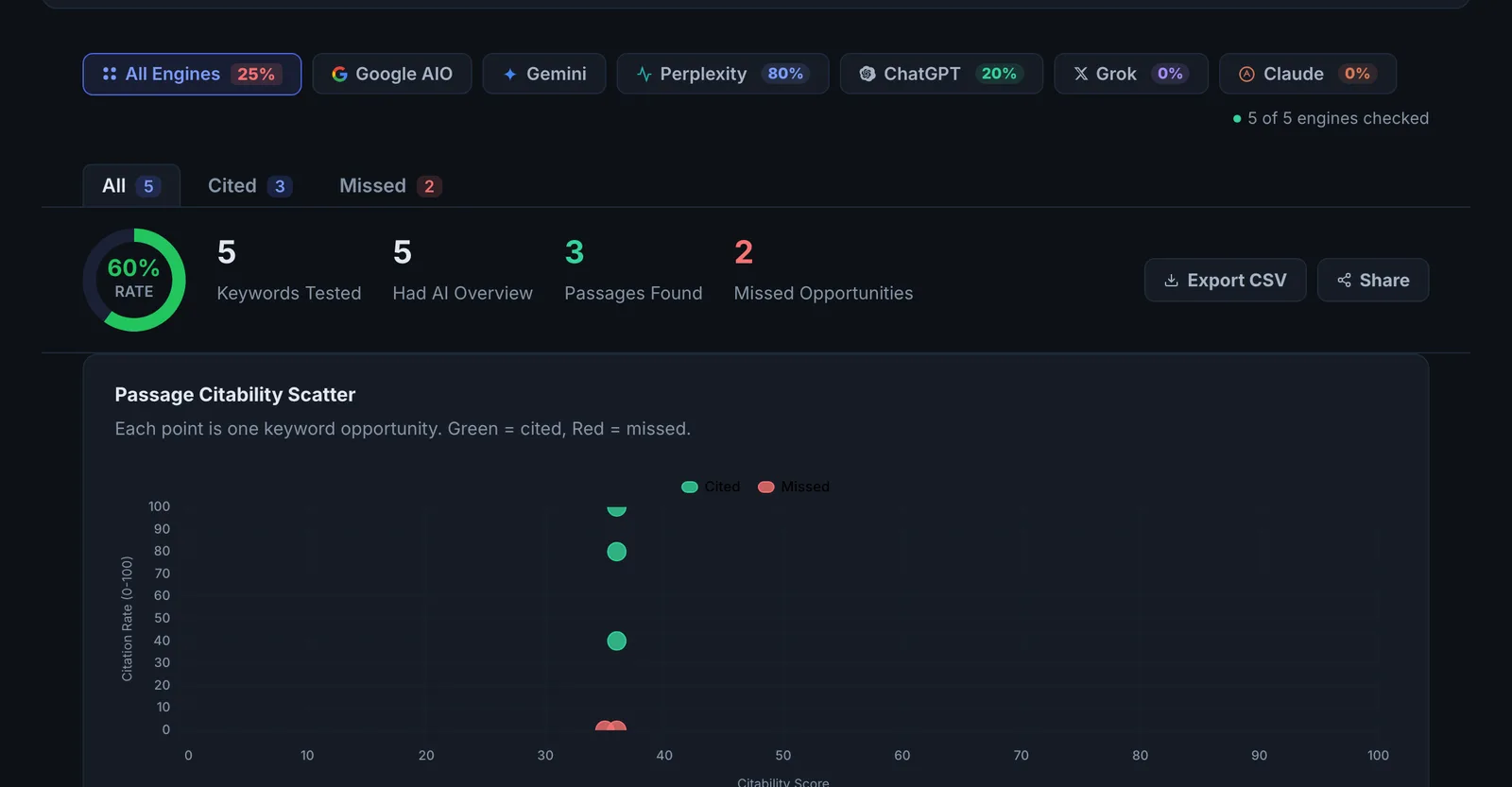
Passage Citations works at paragraph level. For your keywords it finds the exact passage AI Overviews and AI engines quote from your page. For one page and a target query, it simulates retrieval and ranks your passages by how likely an engine is to pick each one.
Step by step
- Open Passage Citations #
Find it under Content, Diagnose, in the left sidebar.
- Choose what to analyse #
Enter a page URL and a target query to simulate retrieval, or your domain (or a page) and up to 6 keywords to find which passages are cited.
- Run it #
For keywords, the AI Overview is read and its quoted text matched to the paragraphs on your page. For a target query, your page is split into passages and ranked.
- Read the passages #
See which paragraph is cited or would be retrieved, its score, and the passages that lose.
- Rewrite the losers #
Rework the passage that should win so it answers the query directly, then re-run.
Why it matters#
AI engines do not cite pages, they cite passages. A page can rank and still lose the citation because the best answer is in the wrong paragraph, mixed with other topics, or too long to lift. Passage Citations shows you the paragraph that is winning (or losing) so you edit the right sentences.
What it checks#
Keyword mode (domain + up to 6 keywords): - A live Google search for each keyword, reading the AI Overview's references. - The quoted text for your page matched to the exact paragraph on it. - Citation checks on the AI engines for the same keywords.
Retrieval simulation (page + target query): - Your page split into passages of meaningful length. - Each passage scored the way retrieval systems score them: semantic similarity plus keyword matching. - Passages ranked from most to least likely to be retrieved.
Reading the results#
- The cited passage is your proven answer. Protect it when you edit the page.
- A cited passage that is not your best answer means the engine found a stray sentence more quotable than your intended section.
- Low retrieval scores across the page mean no passage answers the query directly.
- The top-ranked passage being off-topic means the page mixes topics.
Implementing the fixes#
- Put the answer first. The winning passage should open with a direct, complete answer to the query in one to three sentences.
- Keep passages self-contained. Replace "this", "it" and "as mentioned above" with the actual names, so the passage makes sense out of context.
- One question per section, with the question as the heading.
- Use the query's words. Retrieval mixes meaning and keywords; the exact terms help.
- Re-run the simulation after editing to confirm the right passage now ranks first.
Worked example#
A tax advice site runs 4 keywords. For "what is the standard deduction for 2026", the AI Overview cites the site, and the tool matches the quote to the exact paragraph: a sentence in the middle of a long section about filing status, not the intended summary box at the top.
The summary box is an image with text in it, so engines cannot read it. The fix: the box becomes plain HTML text, and the cited sentence is left where it is, since it is proven. Retrieval simulation for the query then ranks the new summary paragraph first, and the next run shows the AI Overview quoting it.
Best practice#
Use the simulation while drafting, before publishing. It is the cheapest way to test whether a section will be picked.
Troubleshooting
No readable content blocks were found #
The app saysNo readable content blocks found on this page
The page's text is loaded by JavaScript, sits in images, or is split into fragments too short to be passages. Put the main text in the HTML as paragraphs.
The page could not be fetched #
The app saysCould not fetch page
Check the address in a private window and allow CiterankBot if a firewall is involved. See Common problems.
You are cited but no passage is matched #
The engine paraphrased rather than quoted, or cited a different URL on your site (a category or tag page). Check the cited URL shown, and run retrieval simulation on that page.
A rewrite failed #
The app saysRewrite failed, try again
Try again. The original passage is unchanged.
Not listed here? See Common problems for limits, checks, plans and pages that cannot be read.
Questions
How does it know which paragraph was cited? #
What is retrieval simulation? #
Does it use checks? #
Something here does not match what you see in the app? Tell us and we will fix the guide.