 Citerank
Backlink Authority: the authority signals behind AI citations
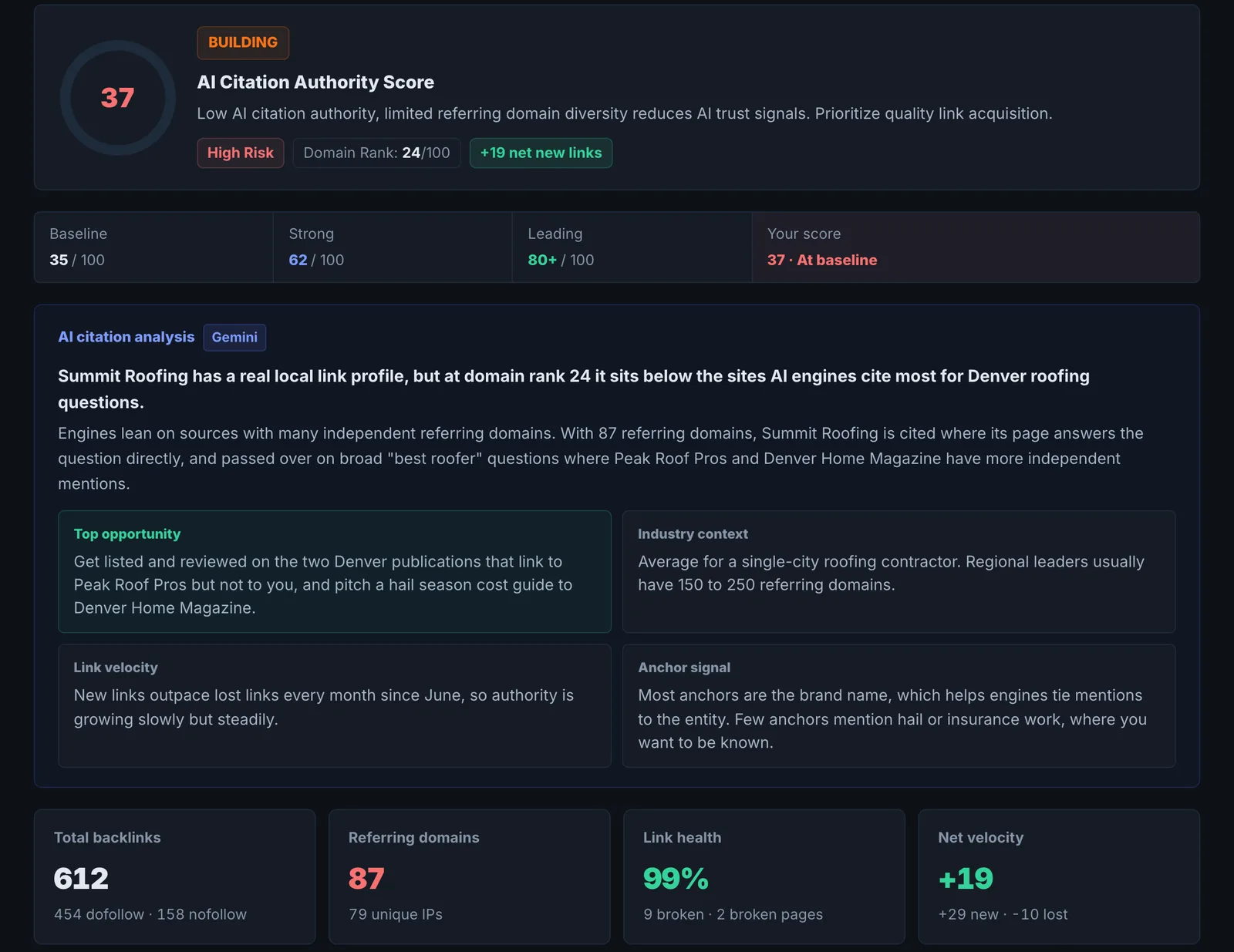
Backlink Authority pulls your link profile (domain rank, referring domains, anchors, history and top linked pages) and, if you add a competitor, the link gap between you, with an AI summary of what it means for being cited.
Step by step
- Open Backlink Authority #
Find it under Competitors in the left sidebar.
- Enter your domain #
Type your domain.
- Add a competitor #
Optional, for the link gap.
- Run it #
Your profile is pulled from DataForSEO in parallel.
- Use the gap #
Target the sites that link to the competitor and not to you.
Why it matters#
Authority is part of why engines trust one source over another, and it feeds the market half of your AI Visibility Score. Backlink Authority gives you the profile and, more usefully, the gap to a competitor, so link work targets sites that already link in your market.
What it checks#
- Summary: domain rank (0 to 100), referring domains and broken backlinks.
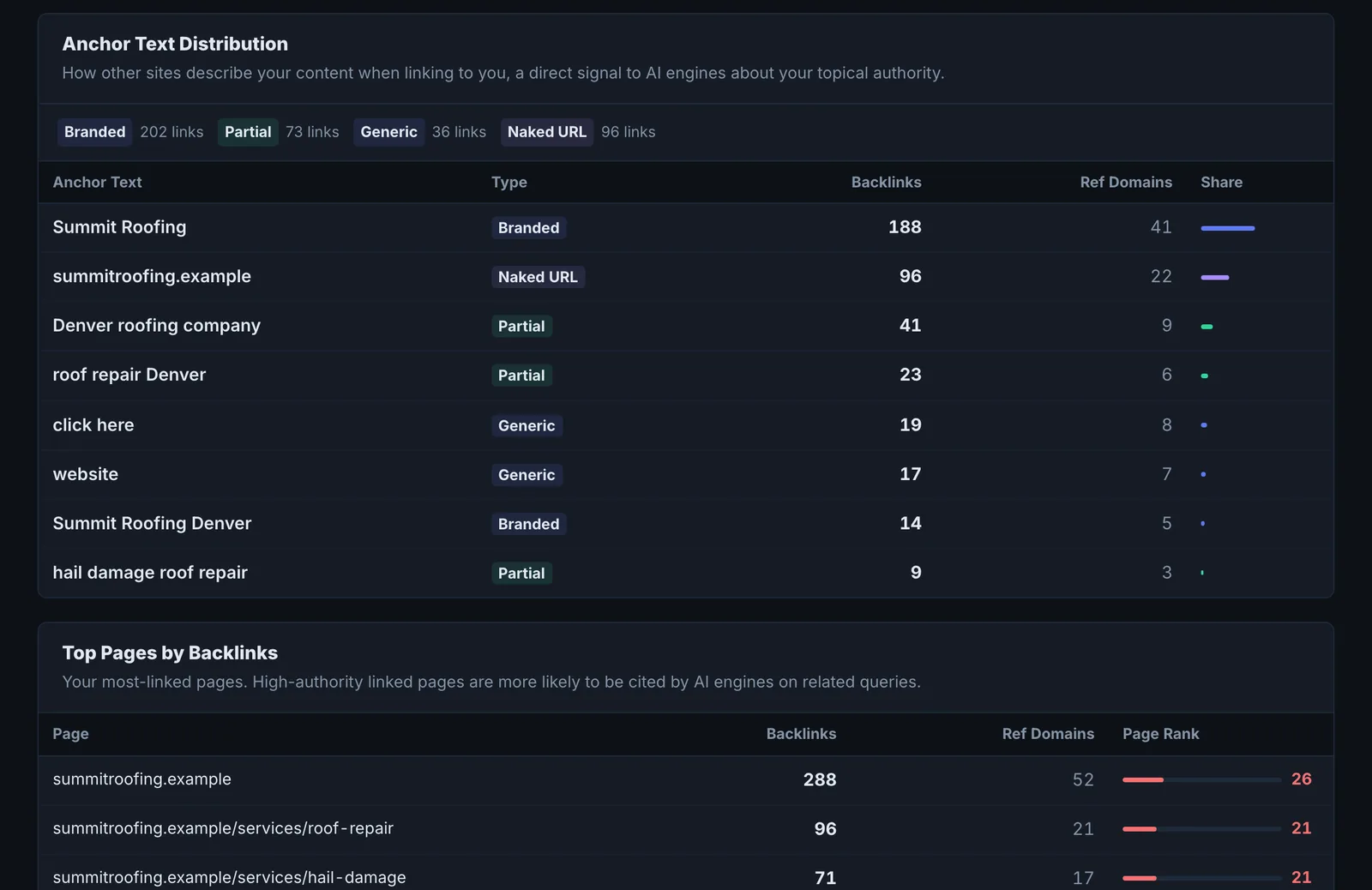
- Referring domains and anchor text distribution.
- History: how the profile changed over time.
- Top linked pages.
- Competitor gap (optional): domains linking to them and not to you.
- An AI summary for AI citation.
Reading the results#
- Low referring domains relative to a competitor is the core gap.
- Anchor text dominated by exact keywords can look manipulative; brand and URL anchors are normal.
- Broken backlinks are links you have already earned and are wasting.
Implementing the fixes#
- Redirect broken backlink targets to live pages.
- Work the competitor gap: industry directories, associations, suppliers and publishers that link to them.
- Earn links with assets people cite: original data, tools and guides.
- Pair with Off-Site Mention Gap so links come from pages AI engines actually read.
Worked example#
A law firm compares its links with a rival that is cited far more often in AI answers.
- Firm: 80 referring domains, domain rank 22, 14 broken backlinks.
- Rival: 410 referring domains, domain rank 41.
- Competitor gap: 60 domains link to the rival and not the firm, including the state bar association's directory, two law schools and a local news site.
- Broken backlinks: 14 links point at an old "/attorneys/" URL that now returns 404.
The fixes: redirect the old attorney URLs to the current bio pages (recovering the 14 links straight away), list the firm in the bar directory, and offer a legal-update column to the local news site. Re-run in three months: 98 referring domains and no broken links.
Best practice#
Run quarterly. Link profiles change slowly, and each run costs more credits than most tools.
Troubleshooting
The numbers differ from another backlink tool #
Every link index crawls a different part of the web. Compare your site with competitors inside one tool, rather than mixing figures from several.
A small or new site shows almost no data #
Link indexes take time to find new sites and links. A few referring domains is normal for a new site. The competitor gap is still useful as a target list.
Broken backlinks point at pages you deleted on purpose #
Redirect each one to the closest live page. The link is already earned; a 301 keeps most of its value instead of losing it.
Not listed here? See Common problems for limits, checks, plans and pages that cannot be read.
Questions
Do links still matter for AI search? #
Does it use checks? #
Something here does not match what you see in the app? Tell us and we will fix the guide.