 Citerank
Citation Causality: why some of your pages are cited and others not
Citation Causality compares your own pages: those Google AI Overviews cite, and those that rank in the top 10 but are not cited (shadow gaps). Because both come from the same domain with the same authority, the differences between them point at page-level causes you can fix.
Step by step
- Open Citation Causality #
Find it under Content, Diagnose, in the left sidebar.
- Enter your domain #
Citerank works out your keywords and checks each one in Google.
- Let it sort the keywords #
Each keyword is put in a bucket: cited, shadow gap, content gap or no AI Overview.
- Read what your cited pages have #
See the signals your cited pages share that the uncited ones lack.
- Fix the pages listed #
Work through Pages to fix, starting with shadow gaps.
Why it matters#
Most tools tell you whether you are cited. This one tells you why, with evidence from your own site. Pages you already rank with are the cheapest citations to win: Google trusts them, it just quotes someone else. Finding what your cited pages do differently gives you a pattern to copy across the rest.
What it checks#
Each keyword goes into one of four buckets:
| Bucket | Meaning |
|---|---|
| Cited | An AI Overview cites your page. Your internal gold standard |
| Shadow gap | An AI Overview exists, you rank top 10, you are not cited. Most fixable |
| Content gap | An AI Overview exists, you do not rank. A content and ranking problem |
| No AI Overview | Google shows no AI Overview for the query |
It then compares page signals between the cited pages and the shadow-gap pages, and also against the pages Google does cite for your gaps.
Reading the results#
- What your cited pages have that the others don't is the core finding: for example direct answers, FAQ sections, schema, freshness or length.
- Pages to fix lists the shadow-gap pages in priority order.
- Compared with the pages Google cites shows what the winning pages have for queries you lose.
- No clear difference means the cause is not structural. Look at the specific answer and the sources chosen.
Implementing the fixes#
- Take the top differentiating signal and apply it to every shadow-gap page.
- Treat content gaps separately: they need ranking work or a new page, not passage edits.
- Re-run after the pages are recrawled and watch shadow gaps move to cited.
Worked example#
A home builder runs 20 keywords.
| Bucket | Count |
|---|---|
| Cited | 4 |
| Shadow gap | 7 |
| Content gap | 5 |
| No AI Overview | 4 |
What the 4 cited pages have that the 7 shadow-gap pages don't: a price range in the first paragraph (4 of 4 vs 1 of 7), an FAQ section (4 of 4 vs 2 of 7) and an updated date in the last 12 months (3 of 4 vs 0 of 7). That is the builder's own evidence, not a general rule.
The fix: the 7 shadow-gap pages get a price range up top, an FAQ section and a refresh. A re-run six weeks later moves 4 of them into Cited. The 5 content gaps become new pages on the content plan.
Best practice#
Run it quarterly. As pages move into the cited bucket, the comparison gets stronger.
Troubleshooting
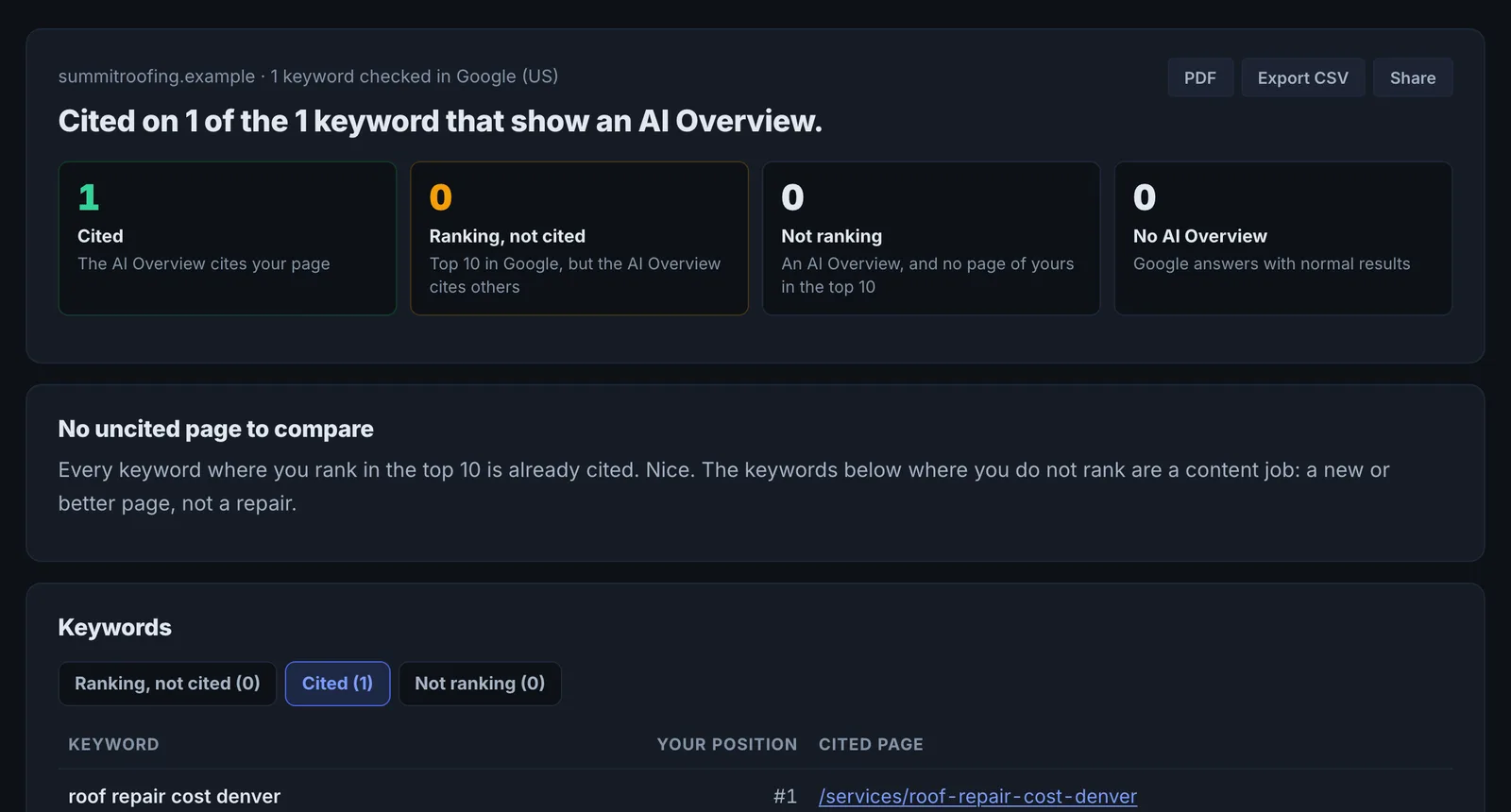
It says there is nothing to compare #
You need at least one Cited page and one Shadow gap page for the comparison. If none of your pages is cited, use the comparison against the pages Google does cite instead.
Keywords could not be derived #
The app saysCould not derive keywords for this domain. Provide a keyword list.
Enter 10 to 20 keywords you rank for in the top 10. Search Console's queries report is the best source.
Most keywords land in No AI Overview #
Google shows no AI Overview for those searches, so there is nothing to be cited in. Use question-style keywords, which trigger AI Overviews more often.
Not listed here? See Common problems for limits, checks, plans and pages that cannot be read.
Questions
What is a shadow gap? #
Why compare my own pages instead of competitors? #
It says there is nothing to compare. Why? #
Something here does not match what you see in the app? Tell us and we will fix the guide.