 Citerank
Semantic Benchmark: depth, entities and information gain against competitors
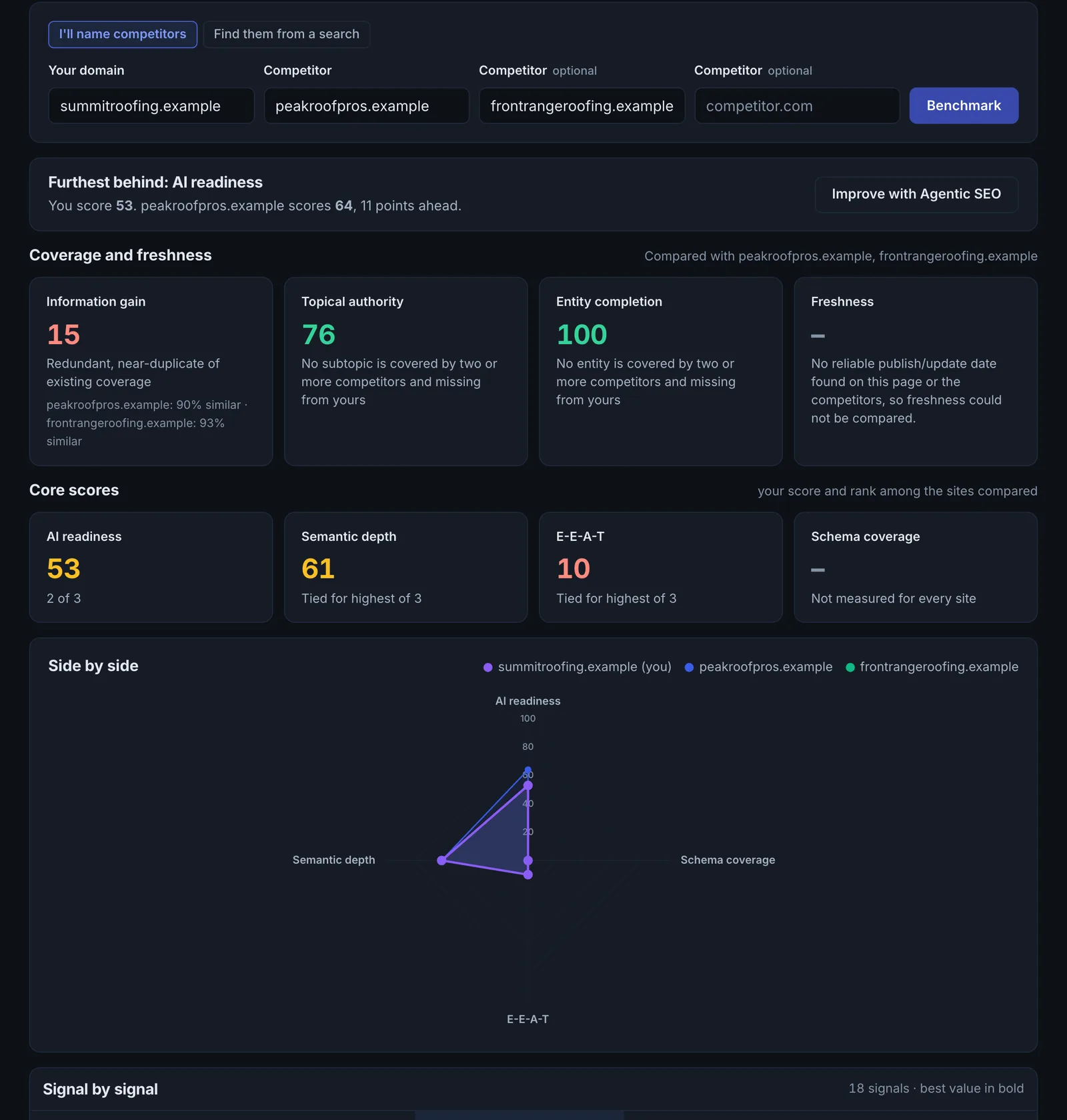
Semantic Benchmark compares your page with up to three competitors, or with the pages that rank for a topic, on semantic depth, entity clarity, schema, freshness and information gain: how much your content adds beyond what already ranks.
Step by step
- Open Semantic Benchmark #
Find it under Competitors in the left sidebar.
- Enter your domain #
Or a specific page.
- Choose who to compare with #
Enter up to three competitors, or a search topic to compare with the top-ranking sites for it.
- Run it #
All pages are read and compared.
- Close the gaps #
Use What they cover that you don't and the signal-by-signal table.
Why it matters#
AI engines gain little from citing a page that says what five others say. Being different in a useful way, with fresher facts and clearer entities, is a reason to be chosen. Semantic Benchmark measures that against the pages you compete with.
What it checks#
| Measure | What it compares |
|---|---|
| Core scores | Schema, semantic depth and the page's other core scores, side by side |
| Coverage | What the competitors cover that you do not |
| Freshness | Who published or updated most recently, from date signals in schema, Open Graph and the page |
| Information gain | How distinct your content is from the competitors, from text embeddings |
Reading the results#
- Information gain bands: Redundant (near-duplicate), Low (mostly restates), Genuine (distinct while on topic) and High (a substantially different angle).
- Freshness: older than most competitors matters most on time-sensitive topics.
- What they cover that you don't: the content gap list.
Implementing the fixes#
- Add the topics competitors cover that you do not.
- Raise information gain with original material: your own data, examples, process, pricing detail or expert view.
- Update the page and its dateModified if your facts are older than the competitors'.
- Re-run to confirm.
Worked example#
A nutrition site benchmarks its "intermittent fasting for women" article against the top 3 ranking pages.
Information gain: Low. The article mostly restates what the others say. Coverage: all three competitors cover fasting and the menstrual cycle; the article does not. Freshness: two competitors were updated this year; the article two years ago.
The fix: a new section on fasting and the cycle, reviewed by a registered dietitian and citing two studies, a table of fasting schedules by goal (something none of the competitors has), and an updated date. Re-run: information gain Genuine, coverage gap closed, freshness level with the competitors.
Best practice#
Use the topic option for pages meant to win a specific query; it compares you with what is actually winning.
Troubleshooting
Competitors could not be found automatically #
The app saysCould not auto-discover competitors for that topic (DataForSEO unavailable or no results). Enter competitor domains manually instead.
Enter two or three competitor domains or page URLs yourself.
Freshness could not be compared #
The app saysNo reliable publish/update date found on this page or the competitors, so freshness could not be compared.
Neither your page nor theirs shows a date in schema, Open Graph or the page. Add datePublished and dateModified to your Article schema and a visible updated date.
The benchmark did not finish #
The app saysBenchmark could not complete: … Try fewer competitors or re-run.
Run it again with fewer competitors.
Not listed here? See Common problems for limits, checks, plans and pages that cannot be read.
Questions
What is information gain? #
Why use a search topic instead of named competitors? #
What should I do with a Redundant or Low result? #
Something here does not match what you see in the app? Tell us and we will fix the guide.