 Citerank
AI Content Editor: research, write and score content for AI citation
The AI Content Editor takes a target query through research (Perplexity plus People Also Ask), builds the content section by section from that research, and scores it live on the signals that make content citable: direct answers, factual density, structure, readability and query alignment.
Step by step
- Open AI Content Editor #
Find it under Content, Create, in the left sidebar.
- Enter the target query #
For example "how to fix water pressure in house". Add your domain if you like.
- Research #
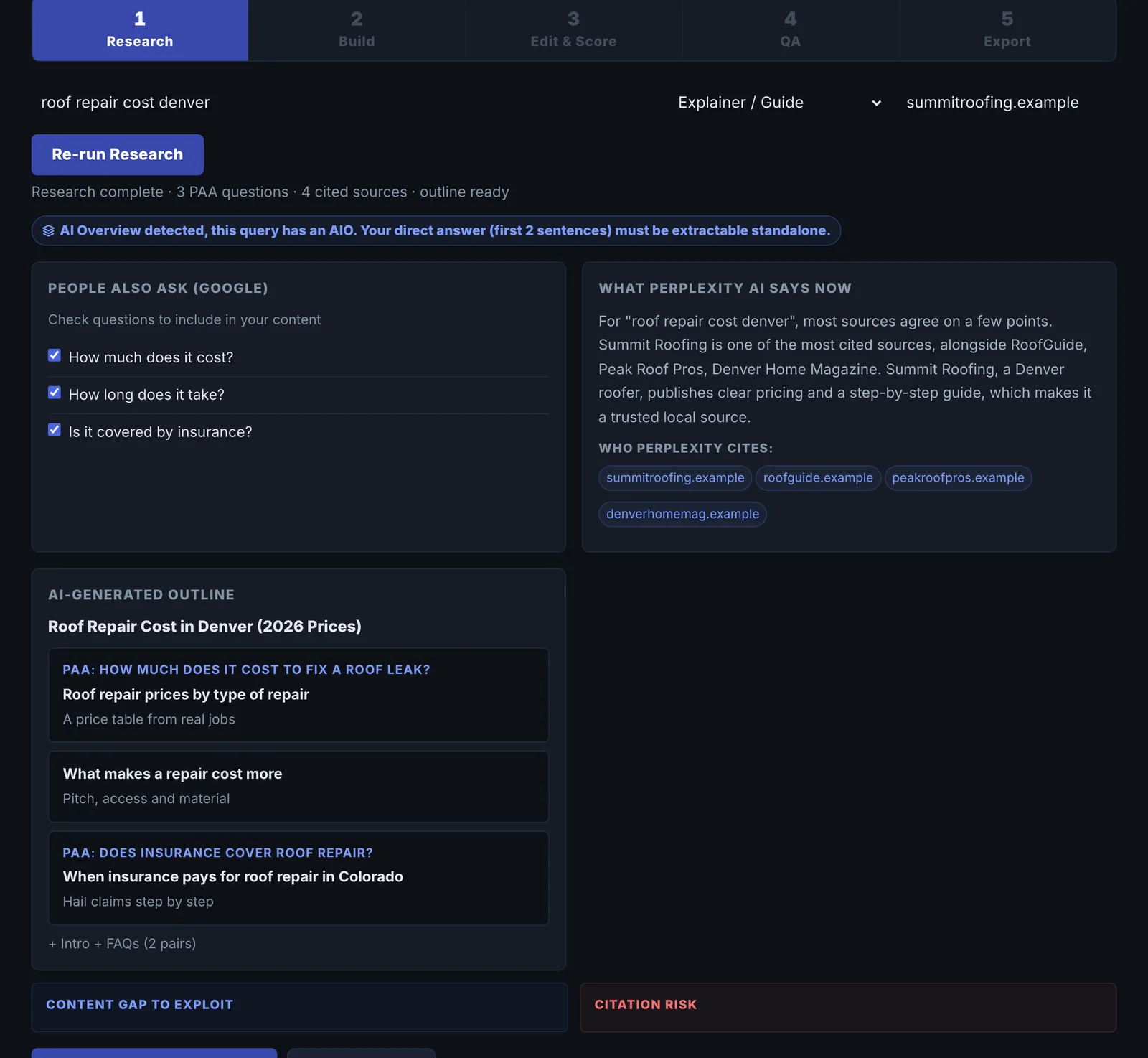
It runs Perplexity and Google People Also Ask research and drafts an outline.
- Build section by section #
Generate the intro, each section, the FAQs and a Q&A, editing as you go.
- Score and refine #
Paste or edit content and watch the score update; rewrite weak passages until they pass.
Why it matters#
Writing for AI citation is a craft: answer first, be specific, keep passages self-contained. The editor builds those habits into the workflow and scores every draft against them as you write, so you see the effect of an edit immediately instead of after a recrawl.
What it checks#
Research: Perplexity research and Google People Also Ask for the query, combined into an outline.
Live score on these signals:
| Signal | What it rewards |
|---|---|
| Length | Passages of about 150 to 400 words |
| Direct answer | A clear answer or definition up front |
| Factual density | Numbers, statistics and named entities |
| Question coverage | What, how, why, when and who |
| Readability | Sentences of around 15 to 20 words on average |
| Schema-friendliness | FAQ pairs, numbered steps and lists |
| Source signals | Citations, attribution and expertise markers |
| Query alignment | How closely the content matches the target query |
| People Also Ask coverage | How many real PAA questions the content answers |
Reading the results#
Each signal shows how the draft scores. The weakest signal is usually the fastest gain: a missing direct answer or no numbers costs more than a slightly long sentence.
Implementing the fixes#
- Direct answer low: add a one or two sentence answer at the start of the section.
- Factual density low: add specific numbers, names, prices, dates and examples.
- PAA coverage low: answer the listed People Also Ask questions in an FAQ section.
- Readability low: split long sentences.
- Query alignment low: use the query's own words in the heading and first sentence.
- Use the rewrite option for a passage that will not improve by hand.
Worked example#
A writer drafts "how to winterize a sprinkler system" in the editor.
Research pulls 6 People Also Ask questions and an outline. The first draft scores well on length and readability but low on Direct answer (the draft opens with a story about a burst pipe), Factual density (no temperatures, times or costs) and PAA coverage (2 of 6).
The edits: a two-sentence answer up top ("Winterize before the first hard freeze, when nights drop below 28°F. Shut off the water, then drain or blow out the lines with compressed air at 50 to 80 PSI..."), a cost line for professional blowouts with the source, and an H2 for each of the 4 missing questions. The score's weakest signals turn green, and the page is published with the FAQ pairs marked up as FAQPage schema.
Best practice#
Start from a Content Brief, write in the editor, then run the finished draft through Citation Predictor.
Troubleshooting
The draft is too short to score #
The app saysContent too short (min 20 chars)
Paste or write at least a paragraph. The score needs text to measure.
A rewrite came back empty #
The app saysNo rewrite generated
The AI did not return a rewrite for that passage. Try again, or rewrite the passage by hand using the weakest signal as the guide.
The score is high but the page is not cited #
The score measures how quotable the writing is. Being cited also depends on authority, crawlability and the competing pages. Check the published page with Why Not Cited.
Not listed here? See Common problems for limits, checks, plans and pages that cannot be read.
Questions
Do I have to use the generated text? #
What length does it aim for? #
Does the editor publish to my site? #
Something here does not match what you see in the app? Tell us and we will fix the guide.