 Citerank
Category Intelligence: who owns AI search for your category
Category Intelligence runs 10 category-defining queries through Google and counts which domains the AI Overviews cite. It shows who dominates, how concentrated the category is, where you stand, and the whitespace: queries nobody owns and queries split among many sources.
Step by step
- Open Category Intelligence #
Find it under Competitors in the left sidebar.
- Enter a topic or category #
For example "commercial roofing" or "CRM for agencies".
- Add your domain #
Optional, to see your position.
- Run it #
Category queries are generated and each checked for AI Overview citations.
- Target the whitespace #
Go after uncontested and fragmented queries first.
Why it matters#
Before you compete keyword by keyword, it helps to know the shape of the market: is AI search for your category owned by one or two sites, or open? Category Intelligence answers that, and shows where the openings are.
What it checks#
- 10 category-defining queries for the topic.
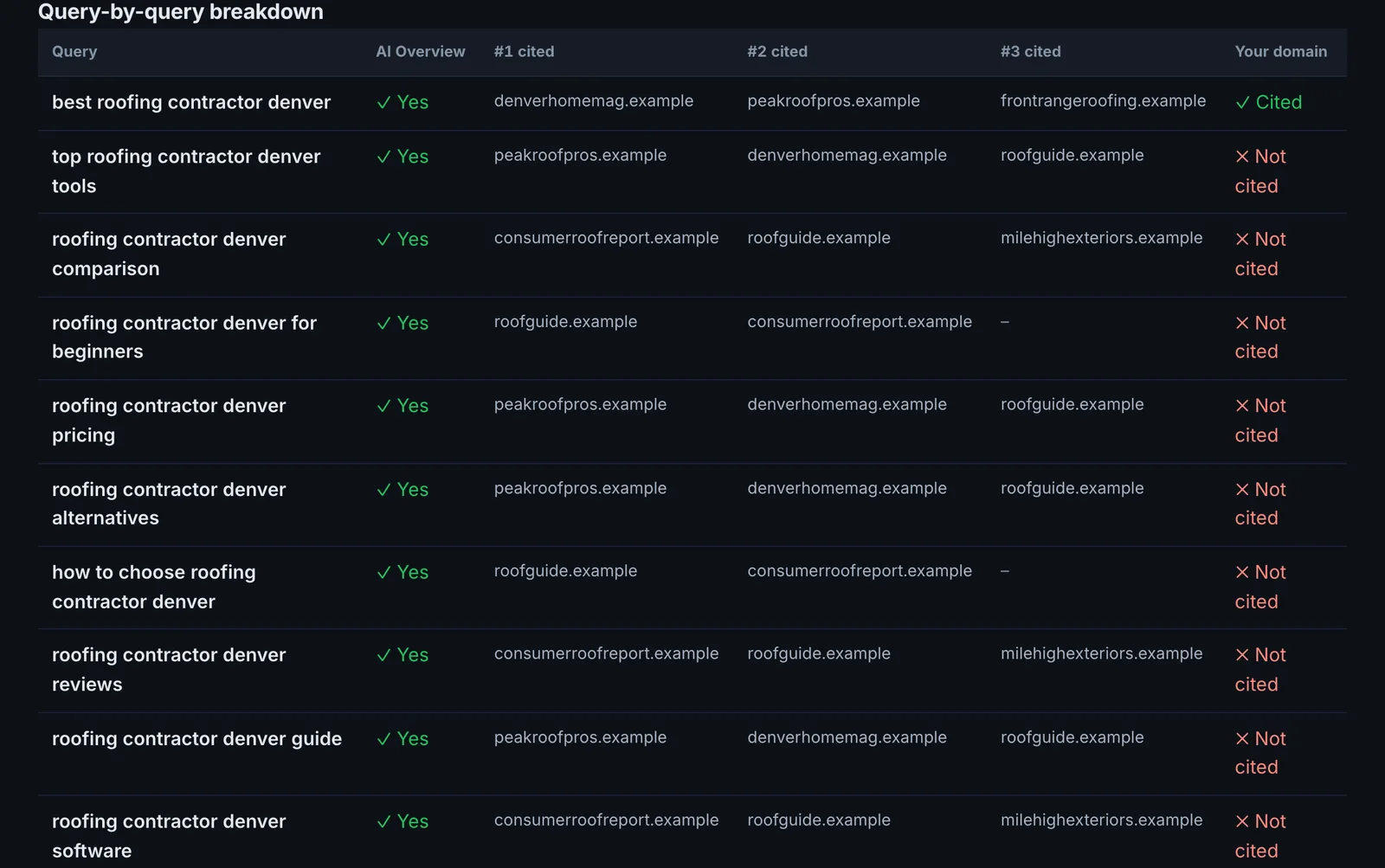
- Each query searched live: whether an AI Overview appears and which domains it cites.
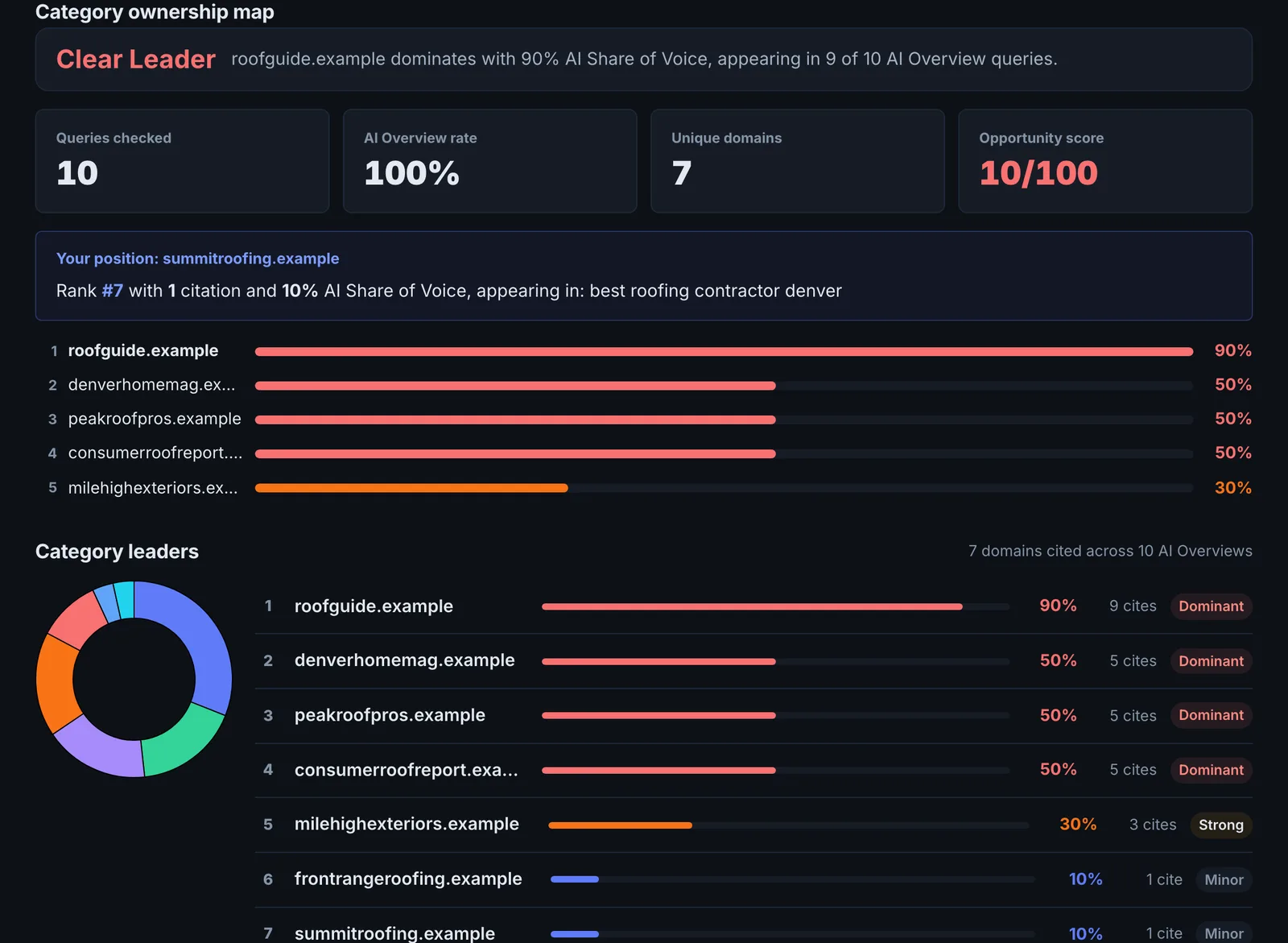
- Leaders: domains ranked by how many AI Overviews cite them, labelled Dominant, Strong and so on.
- Ownership level of the category, and your position if you added your domain.
- Whitespace: uncontested and fragmented queries.
- An AI synthesis of the strategy.
Reading the results#
- One or two Dominant domains: a concentrated category. Compete on the edges first.
- Many Moderate domains: an open category. Consistent, specific content can take share quickly.
- Your position: how many of the category's AI Overviews cite you.
Implementing the fixes#
- Build pages for the uncontested queries first.
- For fragmented queries, make the most complete, specific page in the set.
- Study what the Dominant domains publish and where they are mentioned, and use Off-Site Mention Gap to get onto the same sources.
Worked example#
A pet insurance startup runs the category "pet insurance".
Leaders: two comparison sites are Dominant, cited in 7 of 10 AI Overviews; three large insurers are Strong. The category is concentrated. Whitespace: "pet insurance for older dogs" and "does pet insurance cover dental" are fragmented, with no domain cited more than once.
The strategy: do not fight the comparison sites head on. Get listed and reviewed on them (they are what the engines cite), and own the two fragmented questions with the best page on the web for each: clear answers, a table of what is covered by age, and sources. Re-run in two months: the startup is cited on both fragmented queries.
Best practice#
Run it when entering a new market or service line, before planning content.
Troubleshooting
The queries do not match the category you meant #
The topic is too broad or ambiguous. Use the phrase buyers use, with a qualifier: "pet insurance for dogs" rather than "insurance".
No AI Overviews appear on most queries #
Google shows few AI Overviews in some categories, especially local and transactional ones. The category is then decided by classic results and other engines; check them with AI Engine Breakdown.
Your domain is not in the leaders #
Add your domain to see your position, then work the whitespace queries first. They are the ones no one owns yet.
Not listed here? See Common problems for limits, checks, plans and pages that cannot be read.
Questions
What do Dominant and Strong mean? #
What is whitespace? #
Does it use checks? #
Something here does not match what you see in the app? Tell us and we will fix the guide.