 Citerank
AI Visibility Score: what it measures and how to raise it
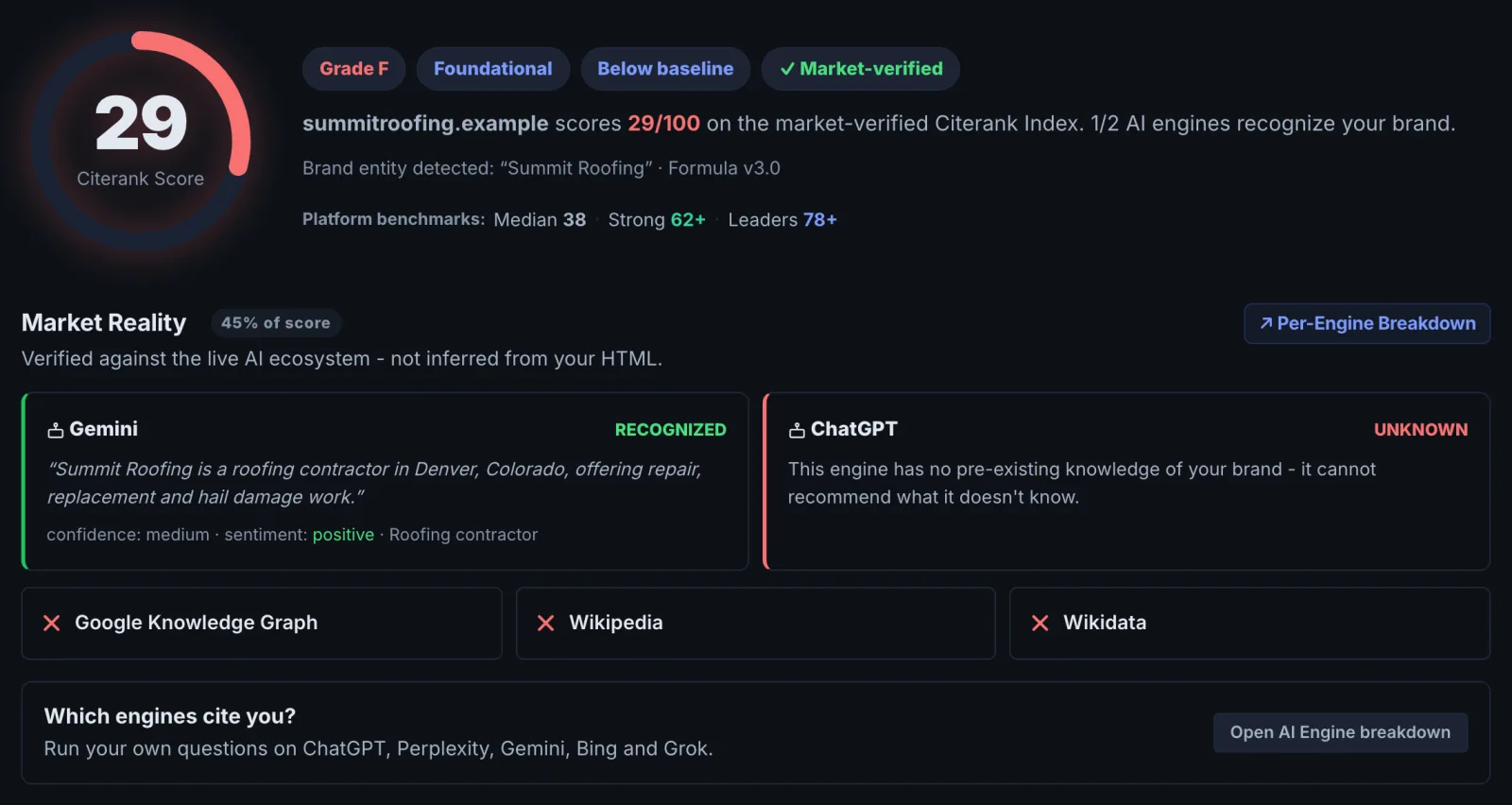
The AI Visibility Score is a 0 to 100 measure of how ready a site is to be read and cited by AI search. Paid plans get the full score: on-site foundation (55%) plus live market evidence (45%), such as real Google AI Overview citations and Knowledge Graph presence.
Step by step
- Open AI Visibility Score #
Find it under Site Audit in the left sidebar.
- Enter your domain #
Type your domain, for example example.com, and run the score.
- Read the headline and the mode #
The chip next to the score says Market-verified (the full score) or On-site only. On-site only means the market dimensions were not measured.
- Find your weakest dimension #
Each dimension shows its score and its weight. The lowest score multiplied by the biggest weight is where points are easiest to win.
- Fix and re-run #
Apply the fixes, then run the score again. If the domain is a project, the new score is saved to its history.
Why it matters#
The score answers one question before you spend money on content or tracking: is the problem that AI engines cannot read and understand your site, or that they can and prefer someone else? Those need different work. A low on-site half means technical fixes you can ship this week. A healthy on-site half with a weak market half means the work is content, authority and mentions elsewhere. It is also the simplest number to report to a client or a boss, and it is free on every paid plan, so you can run it after every change.
What it checks#
On-site foundation#
Five dimensions, measured from your own site:
| Dimension | What it checks |
|---|---|
| Schema & Entity Foundation | Whether your structured data tells AI systems who you are and what each page is |
| AI Discoverability | robots.txt access for AI crawlers, llms.txt, your sitemap, and agent files such as an A2A agent card |
| Agentic Protocol Stack | Machine-usable endpoints such as MCP and OpenAPI. Weighted higher for developer and API sites |
| Content Citability | Whether your content is written in passages an AI engine can quote |
| Entity & Brand Markup | Organization and brand identity markup |
Market reality (paid plans)#
Four dimensions, measured from outside your site:
| Dimension | What it checks |
|---|---|
| Live AI Citations | Whether Google AI Overviews actually cite your domain for relevant searches |
| AI Brand Recognition | Whether AI engines recognise your brand |
| Knowledge Graph Presence | Whether your brand exists in Google's Knowledge Graph |
| Backlink Authority | The authority of the sites linking to you |
How it is weighted#
On a full score (marked Market-verified), the on-site half is 55% and the market half 45%, and within the market half Live AI Citations carries the most weight. On an On-site only score, the five on-site dimensions make up 100%. A dimension that cannot be measured on a run is left out and its weight shared among the others. It is never scored as zero.
Reading the results#
- The mode chip. Market-verified means all nine dimensions ran. On-site only means you are seeing five, so compare like with like.
- Each dimension's score and weight. Points lost = (100 minus the dimension score) times its weight. Sort by points lost, not by the lowest score. A 40 on a 4% dimension costs less than a 70 on a 22% one.
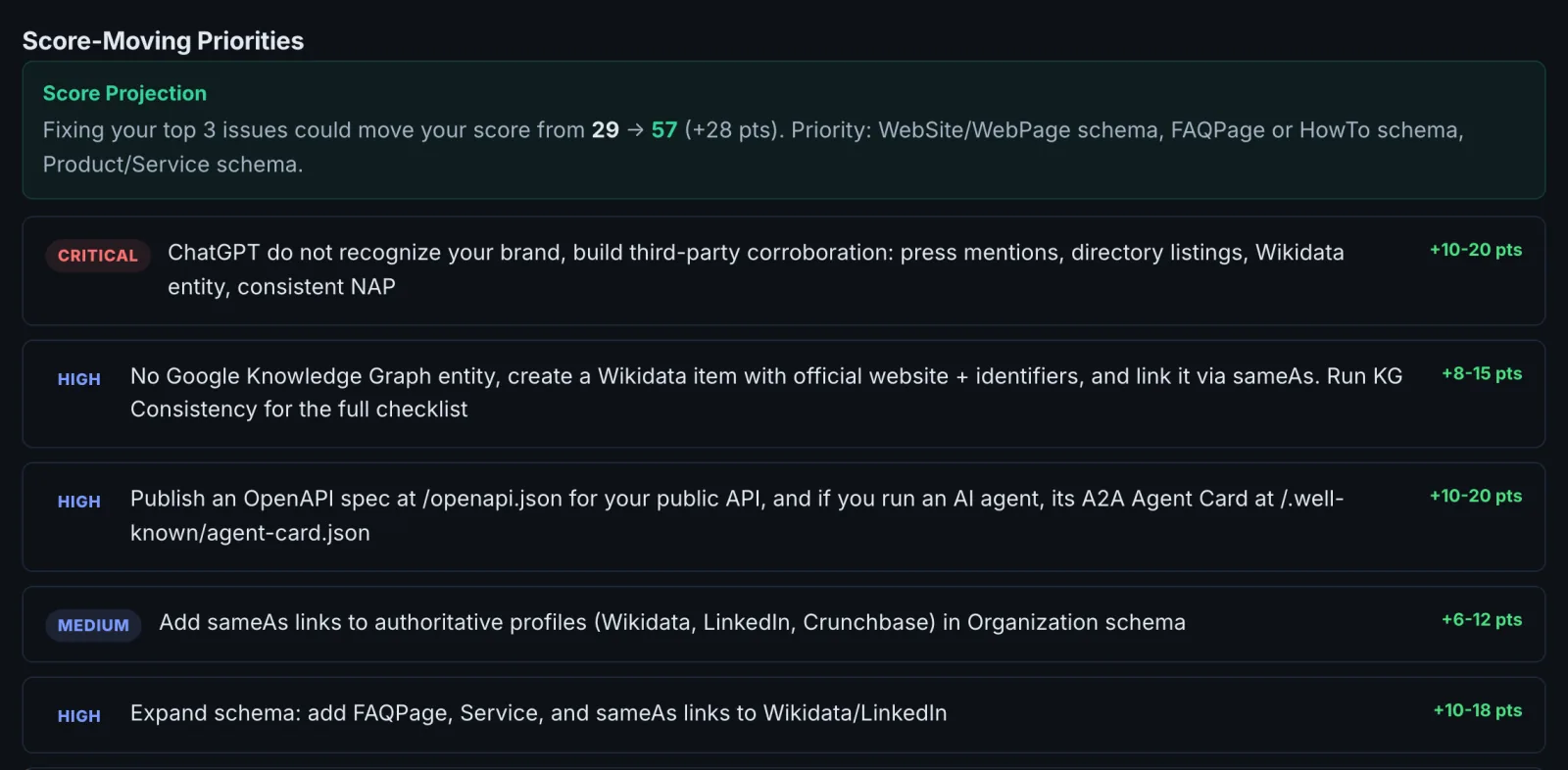
- Quick fixes. Fix cards point at the dimension that loses the most points.
- Movement without changes. The market half uses live data, so a few points of drift between runs is normal. Judge trends over several runs.
Implementing the fixes#
| Weak dimension | What to do |
|---|---|
| AI Discoverability | Allow GPTBot, ClaudeBot, PerplexityBot and Google-Extended in robots.txt unless you have a reason not to. Publish an llms.txt (the llms.txt Generator writes one). Make sure sitemap.xml exists and lists your important pages. Check the result in View as AI Crawler. |
| Schema & Entity Foundation | Add Organization (or LocalBusiness) schema on the home page and the right type on each key page, linked with @id. Use the Schema Generator. |
| Content Citability | Rewrite key pages so each section opens with a direct, self-contained answer. Use the Page Auditor passage scores to find the weak sections. |
| Entity & Brand Markup | Add sameAs links from your Organization schema to your official profiles (LinkedIn, Wikidata, Crunchbase, Google Business Profile). |
| Agentic Protocol Stack | For SaaS and developer products, publish an OpenAPI spec and consider an MCP server. For most local businesses this is low priority. |
| Knowledge Graph / Brand Recognition | Build consistent facts about your brand on the sites engines trust: a Wikidata item, matching profiles, and mentions on industry sites. Slow, but it compounds. |
| Live AI Citations | Follows from the rest. Track the questions that matter in Prompt Tracking and improve the pages that should answer them. |
Re-run the score after each batch of fixes. If the domain is a project, every run is saved to its history.
Worked example#
A dental clinic runs a Market-verified score and gets 48.
| Dimension | Score | Weight | Points lost |
|---|---|---|---|
| Live AI Citations | 20 | high | most |
| AI Discoverability | 35 | medium | second |
| Schema & Entity Foundation | 70 | medium | some |
| Agentic Protocol Stack | 10 | low | little |
The lowest score (Agentic Protocol Stack, 10) is not the priority: it carries little weight for a local clinic. AI Discoverability is: robots.txt blocks GPTBot and ClaudeBot through a security plugin's "block AI bots" switch, and there is no sitemap.
The fixes: turn off the plugin's AI bot block for search and answer crawlers, publish the sitemap, and check it in View as AI crawler. Next run: AI Discoverability rises sharply and the overall score moves into the 60s. Live AI Citations moves later, over weeks, as engines re-crawl, which is why the score is tracked monthly in a project.
Best practice#
- Score your two or three main competitors too. The gap to them is more useful than the gap to 100.
- Run it monthly and after every site release, and keep a note in the project of what changed.
Troubleshooting
The score shows On-site only when you expected Market-verified #
The app saysDeep mode (live citations, engine probes, competitors) requires a paid plan
The market dimensions need a paid plan and a signed-in account. On the free plan you get the five on-site dimensions, which are scored out of 100 on their own. Compare On-site only scores with each other, not with Market-verified ones.
AI Discoverability could not be checked #
The app saysThe site refused or timed out our requests for robots.txt, llms.txt and sitemap.xml, so AI Discoverability could not be checked. A firewall blocking unfamiliar bots is the usual cause.
The dimension is left out, not scored zero. Allow CiterankBot in your firewall (see CiterankBot) and run the score again. If the firewall also blocks AI crawlers, that is the real problem to fix.
The score moved a few points with no changes on the site #
The market half reads live data: AI Overview citations, how engines describe the brand, backlinks. These move on their own. Judge changes across three or more monthly runs, and keep a project note for every site change so movement can be traced.
Not listed here? See Common problems for limits, checks, plans and pages that cannot be read.
Questions
Why did my score change when I did not change anything? #
What is the difference between On-site only and Market-verified? #
Does running the score use checks? #
Is a score of 100 the goal? #
How long before fixes show in the score? #
Something here does not match what you see in the app? Tell us and we will fix the guide.