 Citerank
Perception Score: how AI engines describe your brand
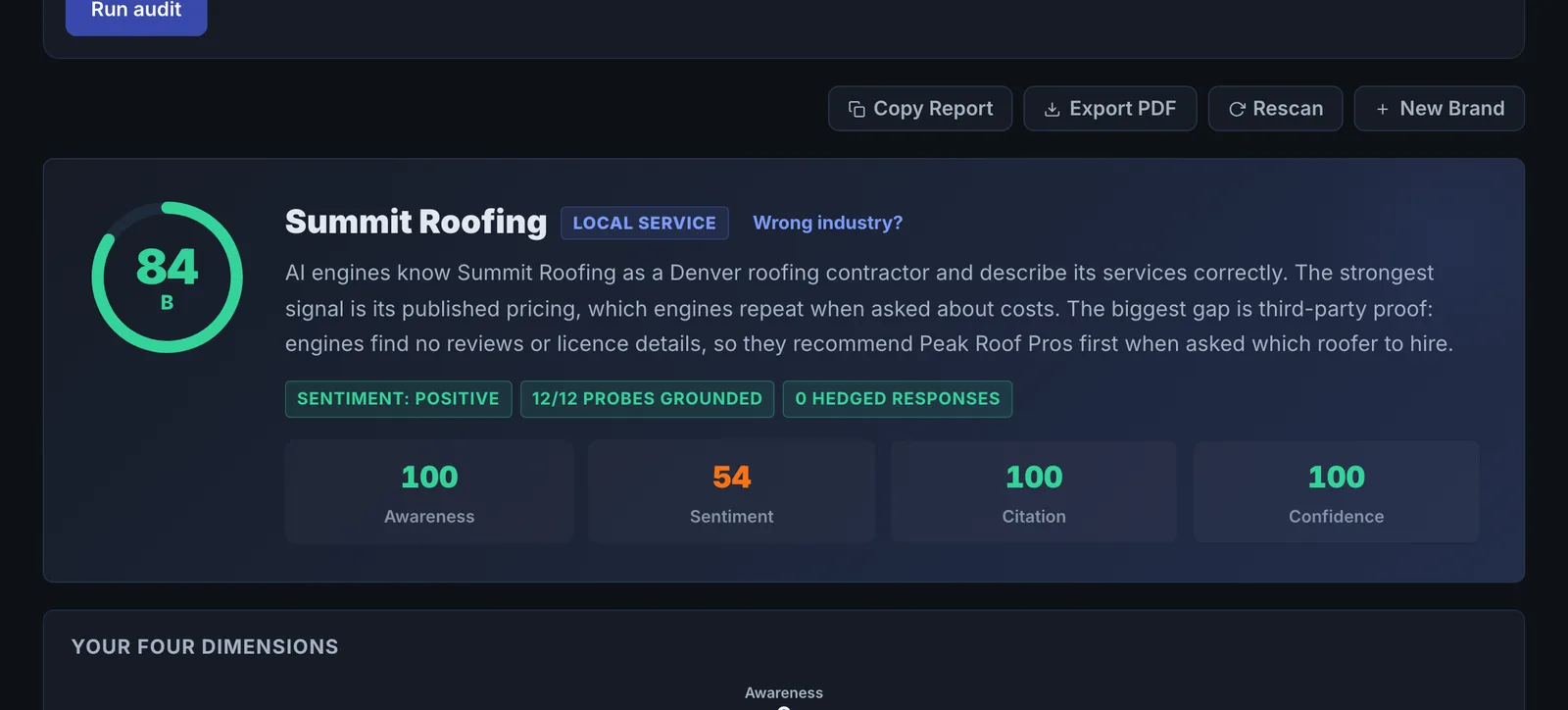
Perception Score asks AI engines category-specific questions about your brand and scores what they say: whether they know you, how they describe you, whether they trust and recommend you. Switch to "What AI remembers" to ask ChatGPT, Claude and Gemini the same with search off.
Step by step
- Open Perception Score #
Find it under AI Visibility, Brand, in the left sidebar.
- Enter your site #
Type your brand's site. The brand name is read from it.
- Set the industry #
Leave it on Detect from the site or choose your industry. It decides which questions the engines are asked.
- Choose the mode #
What AI says, with search, or What AI remembers, with search off. Optionally add a competitor to compare side by side.
- Read the gaps #
Check the scores and the gap analysis for the specific things AI gets wrong or misses about you.
Why it matters#
Being mentioned is not enough if the answer calls you expensive, outdated or second best. Perception Score measures the quality of how AI talks about you, which is what shapes a buyer's shortlist. The memory mode matters because many people use assistants without search, so what the model learned in training is still the answer they get.
What it checks#
What AI says, with search: category-aware questions (chosen from your industry) asked of Gemini with Google Search, with a cross-check on Perplexity and ChatGPT. Each answer is scored for:
| Signal | What it measures |
|---|---|
| Awareness | How often the brand is actually known and mentioned |
| Sentiment | How positive or negative the description is |
| Citation | Whether sources are cited for what is said |
| Confidence | How sure the answer is, from the absence of hedging |
What AI remembers, with search off: whether ChatGPT, Claude and Gemini know you, get your facts right and recommend you from memory alone.
An optional competitor is scored the same way, side by side.
Reading the results#
- Low awareness: engines do not know the brand. That is an entity and mentions problem.
- Low sentiment: read the answers. Usually one or two recurring claims drive it.
- Low confidence: hedged answers ("may", "reportedly") mean thin or conflicting information about you.
- Memory vs search gap: good with search but weak from memory means your recent work has not reached the models yet. The reverse means your current site is weaker than your reputation.
- The competitor column shows whether a gap is yours or the whole category's.
Implementing the fixes#
| Problem | What to do |
|---|---|
| Not known | Build entity signals: Organization schema with sameAs, a Wikidata item where you qualify, consistent profiles, and mentions on industry sites. See Brand Intelligence. |
| Wrong facts | Correct them on your own site (About, pricing, services) and on the third-party pages engines rely on. |
| Negative framing | Find the source of the claim, fix the underlying issue, answer reviews, and publish evidence: case studies, certifications, results. |
| Positioned below a competitor | Publish a factual comparison page and earn inclusion on the comparison and list pages engines cite. |
| Weak from memory only | Keep building mentions and coverage. Models pick it up in later training. Make sure robots.txt does not block training crawlers you are happy to allow. |
Worked example#
A mid-size HVAC company scores itself against a larger competitor.
| Signal | You | Competitor |
|---|---|---|
| Awareness | Low | High |
| Sentiment | Positive | Mixed |
| Confidence | Low | High |
The company is liked where it is known, but rarely known. With search off, ChatGPT and Claude do not know it at all. With search on, Gemini finds it through its reviews.
The fixes: a consistent business description across its site, business profiles and the three HVAC directories the answers cite; local news coverage of a community project; service pages that name the areas served. A run three months later: awareness up a level with search on. Memory mode is unchanged, which is expected: models learn from memory only when they are retrained.
Best practice#
Run it quarterly with the same competitor and industry, and after any rebrand or reputation event.
Troubleshooting
The brand is reported as unknown #
The engines do not connect the name with your business. Common for new or small brands, and for names shared with others. Work on entity signals: Organization schema with sameAs, consistent profiles, and mentions on sites the engines cite.
Search mode and memory mode disagree #
That is a finding, not an error. Strong with search but weak from memory means recent work has not reached the models yet. The reverse means the current site is weaker than the brand's reputation.
The questions do not fit your business #
Questions are chosen from your industry. If they read wrong, the site may not say clearly which category it is in. Make the category explicit in the home page title, opening paragraph and Organization schema.
Not listed here? See Common problems for limits, checks, plans and pages that cannot be read.
Questions
What is the difference between the two modes? #
How is this different from Brand Intelligence? #
Why does the industry matter? #
Something here does not match what you see in the app? Tell us and we will fix the guide.