 Citerank
Citation Predictor: check a draft before you publish
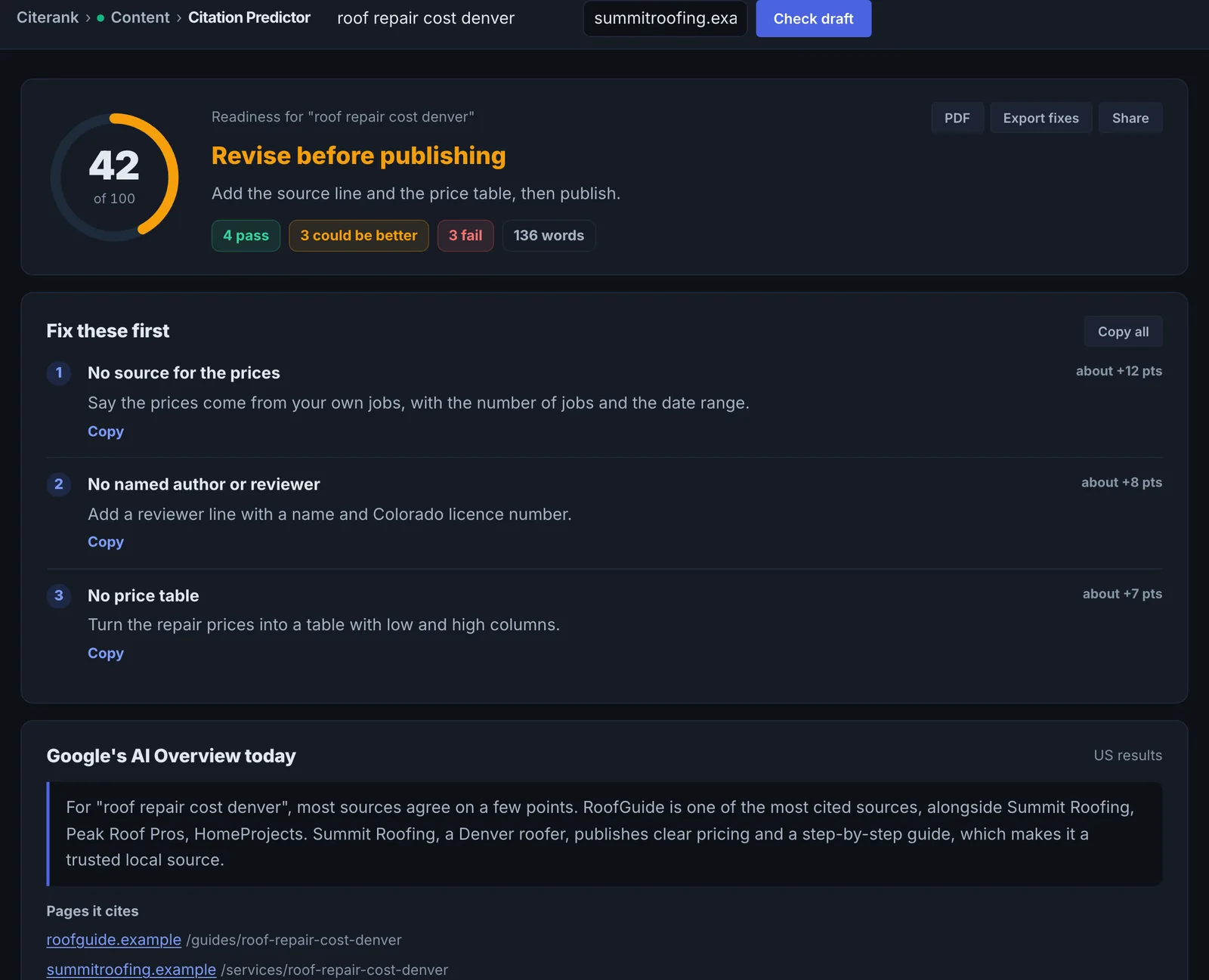
Citation Predictor checks a draft before you publish it. It scores the draft's structure, entities, specificity, schema potential and passage quality, compares it with what Google's AI Overview shows for the topic today, and lists what to fix first.
Step by step
- Open Citation Predictor #
Find it under Content, Diagnose, in the left sidebar.
- Paste your draft #
Paste the full draft, including headings.
- Run the checks #
It analyses the draft and fetches today's Google results and AI Overview for the topic.
- Read Fix these first #
Start with the top fixes, then the full list of checks and the reviewer's notes.
- Edit and check again #
Revise the draft and re-run until the key checks pass.
Why it matters#
Fixing a page after it is published costs a recrawl and weeks of waiting. Checking the draft first costs a minute. Citation Predictor catches the structural problems that stop content being cited (no direct answers, vague claims, few named entities, nothing schema can mark up) while they are still cheap to fix.
What it checks#
| Signal | What it looks for |
|---|---|
| Structure | Headings, direct answers, lists, tables and FAQ pairs |
| Entities | Named people, organisations, products and places, which anchor content for AI |
| Specificity | Numbers, named examples and case studies rather than general statements |
| Schema potential | Content that can be marked up (FAQs, steps, products) |
| Passage quality | Whether sections are self-contained and quotable |
| Today's AI Overview | What Google's AI Overview currently shows for the topic, for comparison |
A reviewer's notes section adds an AI editor's read of the draft.
Reading the results#
- Fix these first is the short list with the biggest effect.
- All checks shows pass and fail on each signal.
- Google's AI Overview today shows what the winning answer currently covers. Anything it covers that your draft does not is a gap.
Implementing the fixes#
- Add a two-sentence direct answer under each main heading.
- Replace generalities with specifics: numbers, names, dates, prices, examples.
- Add an FAQ section for real follow-up questions, and plan the FAQ schema.
- Split long sections so each answers one question.
- Cover any point the current AI Overview makes that you do not.
Worked example#
A marketing team checks a draft on "what is a 401(k) match" before publishing.
Fix these first: no direct definition in the first paragraph, no numbers (no example of a match calculation), and no named sources. Google's AI Overview today covers the typical 50% match up to 6% of salary, vesting, and the annual contribution limit. The draft covers the first only.
The edits: a definition sentence up top, a worked calculation ("on a $60,000 salary, a 50% match on 6% is $1,800 a year"), short sections on vesting and contribution limits citing the IRS, and FAQ pairs. Re-check: all checks pass, and the draft now covers everything the AI Overview does plus a calculation it lacks.
Best practice#
Run every important draft through it before publishing, after the Content Brief and the AI Content Editor.
Troubleshooting
The content is too short #
The app saysContent must be at least 100 characters
Paste the full draft or at least a full section. The predictor scores structure, which needs more than a sentence or two.
There is no AI Overview to compare with #
Google shows no AI Overview for the topic right now. The other checks still apply. Try the topic phrased as a question.
The score is high but the published page is not cited #
The score is a rating of the draft's structure, not a probability. Once the page is live, measure real citations with Citation Tracker and diagnose with Why Not Cited.
Not listed here? See Common problems for limits, checks, plans and pages that cannot be read.
Questions
Is the score a probability? #
Can I use it on a published page? #
Does it use checks? #
Something here does not match what you see in the app? Tell us and we will fix the guide.